
The VP of Engineering is a senior executive who manages development teams and is responsible for the technical strategy and execution of the company’s products or services.
In other words, a Vice President of Engineering is responsible for:
- Ensuring that design requirements are met.
- Overseeing the consistency of user experiences.
- Managing a team of engineers and developers.
If the CTO knows the destination then a VP is identifying the route.
3 Primary Tasks of a VP of Engineering
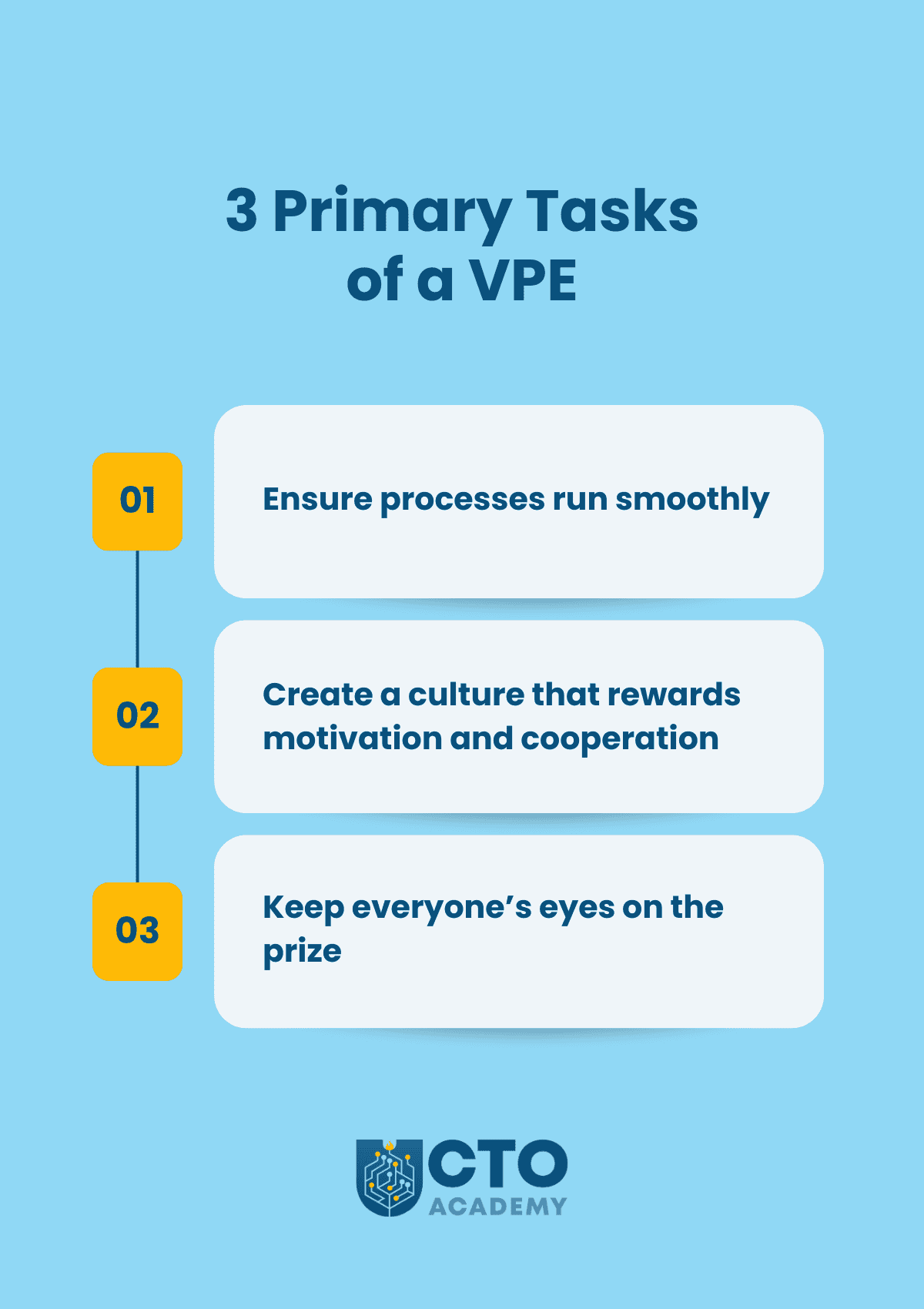
A VPE has three primary tasks:
- Ensure that all processes run smoothly.
- Create a culture that rewards motivation and cooperation.
- Keep everyone’s eyes on the prize.
To make all of this happen, the VP of engineering needs to focus on who is doing the work and how they are doing it. Let’s now explain these tasks in more detail.
VP of Engineering Job Description
While the core responsibilities of a VP of Engineering remain consistent across different company stages, there are notable differences in emphasis and focus between start-ups and fast-growing companies.
The following table best sums it up:
| Feature | VP of Engineering in Start-Ups | VP of Engineering in Fast-Growing Companies |
|---|---|---|
| Primary Focus | Building foundations, hands-on involvement | Scaling the organisation, delegation, strategic focus |
| Team Size | Small, close-knit team | Larger, potentially distributed teams |
| Resources | Limited, requiring resourcefulness | More resources available, but efficient allocation remains crucial |
| Decision-Making | More centralised, often made by the VP directly | More decentralised, empowering engineering managers |
| Technical Direction | More fluid, adaptable to change | More defined, but still needs to maintain agility |
In essence:
- Start-up VP of Engineering: A builder and innovator, laying the groundwork for future growth.
- Fast-growing company VPE: A scaling expert and leader, driving efficiency and alignment as the company expands.
Both roles require a unique blend of technical expertise, leadership skills and business acumen, but the emphasis shifts as the company evolves.
We’ll now explain responsibilities in more detail, separately for start-ups and fast-growing companies.
VP of Engineering in Start-ups
The emphasis is on building foundations. Hence, the VP of Engineering in a start-up focuses on these three areas:
- Establishing the core engineering team.
- Creating the culture.
- Designing processes from the ground up (ie, defining the initial tech stack, setting up development workflows and implementing quality assurance practices).
As you can expect, in start-ups, VPEs have more hands-on involvement with coding, architecture and technical decision-making due to smaller team size and limited resources.
Limited budgets and resources demand creative problem-solving and efficient resource allocation. This often requires pivoting which means that the VP of Engineering must be highly adaptable and able to adjust the technical direction quickly in response to changing market needs and/or immediate state of funds.
And as we move to the next stage of the company’s development, things change.
VPE In Fast-Growing Companies
In this stage, the VPEs play a more significant role in aligning the technical roadmap with the company’s evolving business goals and long-term vision. The focus, therefore, shifts towards scaling the engineering organisation, processes and infrastructure to accommodate rapid growth. This usually includes:
- Hiring and onboarding new engineers.
- Implementing more robust systems.
- Optimising for efficiency.
And since the team grows, the Vice President of Engineering needs to delegate effectively, empower engineering managers and foster a culture of ownership and accountability.
The Challenge of Remaining Agile During Scaling
While scaling is crucial, the VPE must preserve the company’s agility and, thus, the ability to innovate quickly in a competitive landscape. Here is a quick guide to do this job effectively:
1. Modularise the architecture:
- Break down the monolithic architecture into smaller, independent services (microservices). This allows teams to work autonomously, deploy updates frequently and reduce dependencies.
- Implement clear APIs and contracts between services to ensure seamless communication and integration.
2. Empower autonomous teams:
- Organise engineers into small, cross-functional teams with end-to-end ownership of specific product areas or services.
- Give these teams the autonomy to make decisions, choose their tools and deploy their code independently.
- Foster a culture of trust and accountability within each team.
3. Streamline processes:
- Implement agile development methodologies (Scrum, Kanban) to promote iterative development, frequent feedback and rapid adaptation to change.
- Automate repetitive tasks (testing, deployment, infrastructure management) to free up engineers’ time for innovation.
- Continuously evaluate and improve processes to eliminate bottlenecks and inefficiencies.
4. Invest in the right infrastructure:
- Adopt cloud-native technologies and infrastructure (AWS, Azure, GCP) to enable scalability, flexibility and rapid provisioning of resources.
- Implement robust monitoring and observability tools to detect and resolve issues quickly.
- Embrace DevOps practices to automate infrastructure management and streamline deployments.
5. Foster a culture of learning and experimentation:
- Encourage engineers to experiment with new technologies, share knowledge and learn from failures.
- Promote a growth mindset and create a safe space for taking risks.
- Dedicate time for hackathons, innovation sprints and continuous learning initiatives.
6. Prioritise communication and collaboration:
- Establish clear communication channels and encourage transparent information sharing across teams.
- Use collaboration tools (Slack, Microsoft Teams) to facilitate real-time communication and knowledge sharing.
- Foster a culture of open feedback and continuous improvement.
7. Hire for agility:
- Look for adaptable engineers who have a growth mindset and are comfortable with ambiguity.
- Prioritise problem-solving skills, collaboration abilities and a passion for learning.
- Build a diverse team with a variety of perspectives and experiences.
These seven strategies will ensure agility and responsiveness even in times of rapid growth (a unicorn effect).
Differences Between VP of Engineering and Chief Technology Officer Roles
The VP of Engineering and the Chief Technology Officer (CTO) have distinct focuses and responsibilities. Here’s a breakdown of their key differences:
Chief Technology Officer (CTO)
- Sets the overall technological vision and strategy for the company, aligning it with business goals.
- Represents the company’s technology vision to external stakeholders (investors, customers, partners).
- Focuses on long-term innovation, emerging technologies and research and development.
- Concerned with the strategic impact of technology on the company’s growth and competitive advantage.
VP of Engineering
- Responsible for the day-to-day operations of the engineering department, ensuring efficient project execution.
- Manages and leads engineering teams, oversees project delivery and ensures quality standards.
- Focuses on optimising engineering processes, resource allocation and team performance.
- Tackles technical challenges, removes roadblocks and ensures projects are delivered on time and within budget.
In summary, we can say that the CTO is a visionary with an outward focus who drives innovation by thinking about the bigger picture. The VP of Engineering, on the other hand, is an execution expert with an inward focus that demonstrates superior problem-solving skills and operational excellence.
And here is the good analogy that best describes these differences.
Imagine a car company. The CTO is like the chief designer, envisioning the future of automobiles, researching new technologies and shaping the overall brand identity. The VP of Engineering is like the head of manufacturing, ensuring that the cars are built efficiently, meet quality standards and are delivered to customers on time.
Key Differences Summarised:
| Feature | CTO | VP of Engineering |
|---|---|---|
| Focus | Strategic vision and innovation | Operational execution and delivery |
| Orientation | External and future-facing | Internal and present-focused |
| Responsibility | Setting technology direction | Building and managing engineering teams |
| Metrics | Market leadership, innovation impact | Project delivery, engineering efficiency |
Reporting Structure
In many organisations, the VP of Engineering reports to the CTO. This structure allows for clear alignment between the technical vision and its execution. However, in some cases, both roles may report directly to the CEO, especially in smaller companies.
Ultimately, the specific responsibilities and relationship between the CTO and VP of Engineering can vary depending on the company’s size, structure and industry.
VP of Engineering Salary
The average salary for a Vice President of Engineering in the United States varies depending on the source and factors such as experience, location and company size. Here are some recent figures:
- According to Salary.com, the average annual salary is approximately $297,213, with a range typically between $264,753 and $335,333.
- Indeed reports an average salary of around $211,132 per year.
- ZipRecruiter lists the average annual pay at about $215,595.
- Comparably states the average salary is $239,461 per year.
In the UK, figures are somewhat different:
- PayScale reports an average annual salary of £101,307, with a range typically between £75,000 and £139,000.
- According to Salary.com, the average salary is around £126,352 per year, with a range from £98,795 to £153,075.
- Indeed lists the average salary at approximately £126,769 per year.
These figures should give you a good idea of what to expect for this role in the UK. And you can search for VP Engineering jobs by visiting any of these links, of course.
Conclusion
Becoming a great VP of Engineering is a journey that requires a unique blend of technical expertise, leadership acumen and strategic thinking. It’s about more than just writing code; it’s about building and empowering high-performing teams, driving innovation and aligning technology with business goals.
And here’s a handy roadmap to that role:
1. Master Your Craft:
- Develop deep technical expertise.
- Gain hands-on experience.
- Stay curious and keep learning.
2. Cultivate Leadership Skills:
- Embrace a growth mindset.
- Develop strong communication skills.
- Build a collaborative culture.
- Become a mentor and coach.
3. Embrace Strategic Thinking:
- Understand the business context.
- Develop a product mindset.
- Think long-term.
- Connect with other engineers.
- Engage with the broader tech community.
- Build relationships with stakeholders.
5. Seek Opportunities for Growth:
- Take on leadership roles.
- Seek out challenging assignments.
- Embrace continuous learning.
We work with people in this role from around the world, helping them build the leadership skills and confidence to progress their career to the most senior roles including CTO.
If you’d like more information about what it takes to become a VP of Engineering, get in touch with us.
