
Operationalizing machine learning is no longer optional because AI initiatives have moved beyond prototypes. Tech leaders must, therefore, ensure scalability, maintainability, and compliance. This article provides a clear MLOps pipeline for production-level machine learning.
First, here’s a visual presentation of the process:
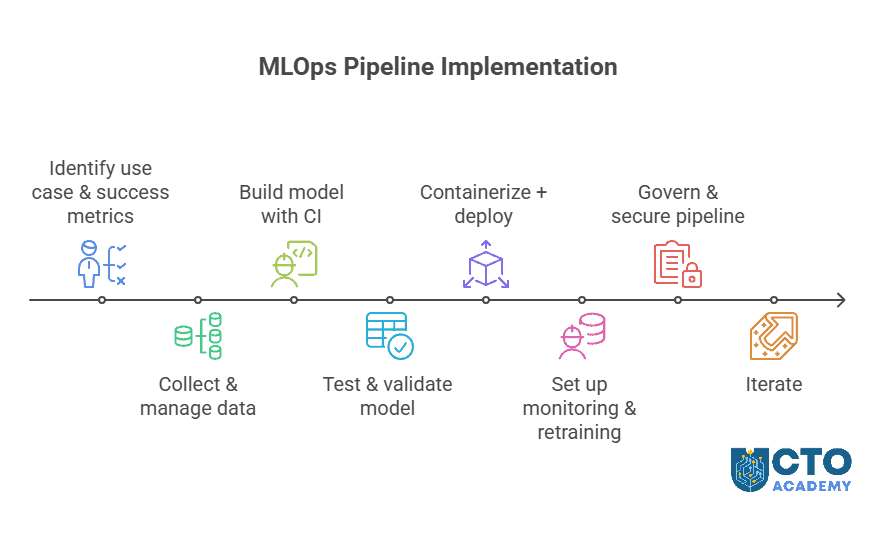
1. Identify Use Case and Success Metrics
- Clarify the business impact: fraud detection, churn prediction, or dynamic pricing.
- Define measurable KPIs, such as ROC-AUC or inference latency, and align stakeholders.
2. Collect and Manage Data
- Centralize version training data using platforms like DVC or Delta Lake.
- Automate ingestion and validation to ensure data quality across iterations.
3. Build Models with Continuous Integration
- Use CI/CD tools to train models automatically when data or code changes.
- Include automated unit tests, model evaluation, and logging to maintain reproducibility.
4. Validate and Test Models
- Run A/B tests or canary releases with shadow deployments.
- Ensure models perform within accepted tolerances
- Ensure that rollback mechanisms are in place.
5. Containerize and Deploy
- Use Docker to encapsulate models.
- Choose Kubernetes or serverless infrastructure for scalable deployment.
- Monitor resource usage and response time.
6. Monitor and Retrain Automatically
- Track data drift, concept drift, and model degradation.
- Implement automated triggers for retraining.
- Implement alerts to human reviewers when anomalies arise.
7. Ensure Governance and Security
- Audit model lineage and access controls.
- Enforce compliance with GDPR, HIPAA, or sectoral regulations.
- Document decisions and risk assessments.
By structuring your ML lifecycle with these MLOps principles, you reduce technical debt and increase your team’s velocity from research to production.
