Category: Leadership Skills

  • How to Be an Effective CTO

    How to Be an Effective CTO

    How can you, a newly appointed CTO, stand out among the senior leadership team? In other words, how can you prove your worth at the senior executive level?

    Based on Julian Costley’s lecture from CTO Academy’s Digital MBA for Technology Leaders and several live sessions with our alumni, this article unpacks practical strategies and, more importantly, key traits of an effective Chief Technology Officer.

    TL;DR: Seven evidence-backed principles—ADR discipline, FinOps alignment, Tech-Debt Sprints, Shadow-Ship Days, fatigue-aware alerting, scheduled learning hours, and continuous self-care—equip new and seasoned CTOs to deliver commercial impact while protecting team well-being.

    Now, before we dive into the subject, take a moment and picture your first week in the role: the CEO is asking how you’ll shave 15% off cloud spend, engineering wants clarity on a crumbling monolith, and the board expects a growth roadmap by next quarter. 

    That moment—when every stakeholder looks to you for a decisive, technical-yet-commercial answer—is where effective CTOs differentiate themselves. The seven principles that follow distill what the most successful leaders do next.

    7 Principles of Modern Technology Leadership

    The first thing to understand:

    1. It’s Not About Being Loud or Flashy

    It’s about behavioral sharpness, operational precision, and leadership that stretches beyond your designated role

    You see, CTOs possess the unique ability to turn the tide in strategic organizational growth, but doing so means mastering both technical and leadership dynamics.

    Jason Noble, CTO at CTO Academy, has seen firsthand how tough this transition can be: “I recently spoke with a CEO who was frustrated that every technologist they approached jumped straight to building solutions—without first understanding the organisation’s needs or the daily friction points that would slow delivery. Their website refresh was already eight months behind schedule. Together, we reframed the approach so stakeholders could engage more easily and the CEO could feel confident that the deliverables were realistic.”

    The fact is, a modern CTO isn’t confined to a tech cubicle. Along with executing your objectives, the modern requests of the role demand a mindset transformation. It comes down to these three subprinciples:

    1. Leading with intent.
    2. Contributing to cross-company strategies.
    3. Creating a meaningful impact rather than just noise.

    Having learned that influence isn’t measured in decibels but in deliberate presence, the next step is to turn that quiet authority into consistently constructive behavior—the focus of our next principle, Mastering Behavioral Effectiveness.

    2. Master Behavioral Effectiveness

    An effective Chief Technology Officer doesn’t cause headaches for their fellow executives. In fact, it’s quite the opposite. They appear calm, logical, and steady, especially compared to the often theatrical sales or marketing leads. 

    View Post

    Think of it like blending into an executive group photo: you don’t have to push to the front to make your contributions seen.

    Being behaviorally effective boils down to this:

    • Keep it actionable. In other words, provide information that others can act upon, but don’t overwhelm them with irrelevant data.
    • Layer communication by using levels of information, ranging from key reporting at the top to in-depth analytics only when asked.
    • Build trust. That is, don’t hide problems; instead, take calculated risks that you openly discuss and address.

    Behavioral effectiveness is not just about your outward demeanor, but also fostering environments where honesty, precision, and proactivity thrive.

    A polished demeanor alone won’t move the business unless your ideas are conveyed with crystal clarity, which is why we now structure every message through the Information Pyramid.

    3. Communicate with the Information Pyramid

    Imagine all the trends, data points, and statistics you deal with as an information pyramid, as shown in the image below: 
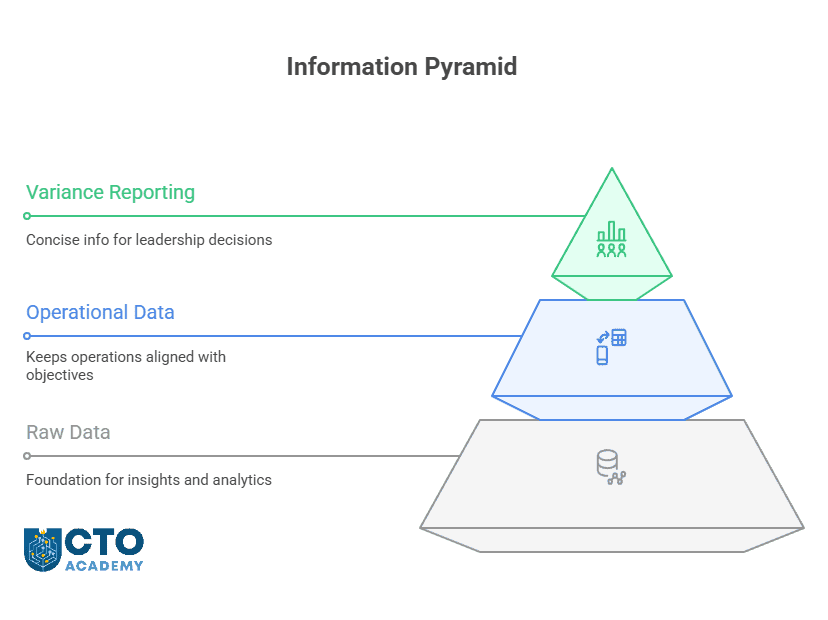
    Three-layer Information Pyramid showing Outcome, Insights, Data an effective CTO uses in communication

    At the top is leadership’s go-to: concise variance reporting. This is what they need to know to make informed and effective decisions. In the middle lies operational data, which helps you stay functional and aligned with team objectives. Finally, the base level holds raw data and analytics, the foundation for insights.

    Here’s how to think and communicate effectively with this pyramid in mind:

    • Be clear. Resist the urge to overwhelm your team or SLT with an avalanche of stats. Instead, focus on actionable insights.
    • Always have the details within immediate reach. While you provide top-level clarity, layer information so that deeper data is available upon request.
    • Think like the Board. Bridge your technical skills with business-focused delivery of insights.

    Once insight is transmitted cleanly, the real test is converting it into flawless execution—enter Operational Mastery, where communication meets action.

    4. Build Operational Mastery

    Possessing a skillful team, ample resources, and clearly outlined objectives might feel like a formula destined for success. But there’s a catch—it’s called organizational friction

    Many accidental CTOs overlook how easily operational effectiveness can go off track. Inefficiencies—or even sabotage—from misaligned colleagues can quickly derail their progress.

    “Every project will have a tough problem to solve—whether it’s cleaning messy data, developing a new algorithm, or scaling a prototype without running into excessive live production costs. If these issues aren’t addressed promptly, they become ‘if-by-magic’ steps that everyone assumes someone else will handle. In some organisations, it takes real courage to raise these concerns early on,” says Jason Noble.

    To safeguard against such challenges, execute these countermeasures:

    1. Document Everything 

    Write down agreements, keep meeting notes, and maintain a record of important decisions. 

    For instance, implement Architecture Decision Records (ADRs) where you log every irreversible tech choice (e.g., adopting event-driven messaging) in a one-page ADR template stored alongside the code. 

    Rolling out lightweight ADRs lifted engineers’ “satisfaction with how we document” from 2.5 → 3.1 on a 4-point scale in just three months (Feb – Apr 2024) during an action-research rollout at a 19k-employee Swedish firm.

    1. Form Partnerships

    Build and maintain a strong, collaborative relationship with your manager and SLT in general. Always keep in mind that open communication increases trust and limits misunderstandings.

    1. Practice the “6-Week Tech-Debt Sprint” 

    Reserve one sprint every two quarters where 100% capacity tackles the debt backlog; publish before/after cycle-time metrics. 

    A single time-boxed cleanup on a marketplace platform can drive a 66% reduction in median cycle time and cut work-in-progress by half.

    1. Navigate Office Politics

    Allocate a necessary percentage of your focus to assess and protect your standing within the company. It is an investment with an extremely high ROI. 

    An example is organizing CFO Pair-Reviews on Cloud Spend, where you schedule a 30-minute monthly FinOps session with Finance to translate AWS/GCP costs into gross-margin impact. 

    Brazilian fintech Ouribank, for instance, slashed AWS spend by 60% and boosted processing capacity by 18% after instituting tag-driven cloud-cost sessions co-led by tech and finance, in under 12 months (FinOps program launched in 2024; results reported on March 18, 2025).

    With a friction-resistant delivery engine humming inside engineering, the natural progression is to project that capability across the organization, exactly what the next principle delivers.

    5. Boost Your Value Outside the Immediate Role

    It’s tempting but misleading to believe that being the best at your core technical functions is enough. 

    Efficient CTOs don’t just stay in their lane. Your ability to adopt new roles, share insights into marketing or sales strategies, and provide fresh cross-departmental viewpoints boosts your executive presence.

    Here are three simple practices that help you think outside the box, literally and figuratively:

    1. Contribute to ideas that stretch beyond your department, fostering respect from leaders across the organization. For example, host “Shadow-Ship” Days with Sales Engineers, where you rotate backend engineers through high-stakes customer demos to feel real-world pain points and speed up feature fit. At BlackLine, for instance, opportunities that included a shareable DemoBoard built by solutions engineers closed with a 54% higher win rate, while live demos dropped 29% across the first 12-month rollout (case-study data published in 2025).
    2. Maintain visibility by actively briefing other teams and board members on your work.
    3. Find growth opportunities by attending board meetings as an observer and preparing ahead of potential questions.

    And never underestimate the power of a proactive appearance. Whenever possible, bring potential solutions to problems before they emerge on your boss’s radar.

    Now, here’s the problem: expanding your sphere of influence can stretch even the best leaders thin. That’s why the next principle turns inward, protecting the leader behind the results through well-being.

    6. Protect Your Well-Being While Doing All the Above

    Long hours, high stakes, and the weight of expectations are nearly inseparable from the CTO experience. As much as you advance the organization, you also need to anchor yourself. Personal health, both mental and physical, is the foundation.

    Therefore:

    • Don’t bank on a perfect work-life balance, but aim for routines that keep you resilient.
    • Maintain mental clarity to handle unexpected challenges and maintain your status as a “go-to” leader.

    PagerDuty’s AIOps fatigue dashboard’s early-access customers cut alert-noise by 87% and triggered automated incident response 9x faster, slashing the overnight page load that burns engineers out. 

    Exercise: audit your own alert volume this week—if a page can’t change an outcome, silence it.

    Safeguarding health provides staying power, but maintaining an edge demands perpetual growth; hence, the final principle: Learn While Leading.

    7. Learn While Leading

    Growing as a tech leader means seeing beyond the familiarity of your industry. 

    When Food Rescue Hero’s Head of Engineering, Ameesh Kapoor, joined Amazon’s “Now Go Build” CTO Fellowship in November 2024, he blocked a weekly “learning hour” to pilot one insight from each peer-sprint in production. Twelve months later, the platform was engaging 50k volunteers across 20 North American regions. His example serves as proof that carving out structured learning time while leading can translate straight into organisational scale.

    Try this week:

    Block a single 60-minute “learning hour” in your calendar right now. During that slot:

    1. Pull one fresh idea from outside your bubble—a peer-sprint note, podcast nugget, or conference deck.
    2. Prototype it immediately (feature flag, shell script, or process tweak) and ship to a low-risk environment before the hour ends.
    3. Log the outcome in a one-page “Learning Log” and demo your findings in Friday’s stand-up.

    *Tiny proof it pays: The 2023 Accelerate State of DevOps Report shows teams that foster a generative culture—typically by ring-fencing regular learning time—achieve 30% higher organisational performance than teams that don’t.

    Additionally, DORA’s 2024 research shows teams that treat learning as a first-class activity ship more often and recover faster, thanks to the compounding effect of weekly micro-experiments.

    You see, knowledge expansion, outside the narrow scope of your current frame, shapes you into a sharper, more rounded leader.

    The question is, how do you expand your knowledge beyond the most imminent domain and role? 

    It’s a rather simple formula: networking + curiosity

    • Build connections outside your organization by attending conferences, joining industry boards, or cultivating informal mentorships. 
    • Read beyond tech. Explore finance, psychology, and management subjects that inspire creative lateral thinking.

    These practices help align your technological capabilities with broader business strategies, providing exceptional value not just in operational settings but also within senior management.

    Key Takeaway

    Aim Higher and Broader

    Succeeding as a CTO isn’t pure technical wizardry. It’s being the steady strategist, skillful communicator, and inspiring leader who truly influences company growth. Therefore, think big and speak up. And never stop identifying how you can contribute more than before. 

    Every tech leader has the potential to be indispensable; navigate to that peak with intentional effort by implementing these seven principles. 

    CTO Academy

    They’re more than placeholders—each question addresses a pain point you and your readers actually face, and there’s credible data you can cite to back up the answers. Below is a tightened, publication-ready FAQ block you can drop straight into the article (e.g., after the Key Takeaway and before the MBA CTA). I’ve included real-world metrics and sources so the answers feel authoritative, not hand-wavy.

    Quick-fire FAQ

    How can I persuade my CEO to fund a Tech Debt Sprint?

    Point to concrete business wins: a 2023 case study showed that a single six-week cleanup cut median cycle time by 66 % and halved work-in-progress on a marketplace platform, boosting on-time delivery predictability.
    Tip: package your request as a fixed-length experiment with before/after engineering KPIs and revenue-linked outcomes.

    What’s the ideal length for an ADR template?

    Keep it on a single screenshotable page (context → decision → consequences → reviewers). AWS’s 2025 best-practice guide stresses “focus on a single decision” and “keep ADRs concise,” noting that splitting large topics preserves speed and clarity.

    How much of my budget should go to FinOps tooling?

    Deloitte’s 2024 FinOps forecast warns that costs should stay around 3 – 5% of annual cloud spend; organisations that exceed this rarely see positive ROI.
    Rule of thumb: if the tooling doesn’t pay for itself with ≥5× savings inside a year, revisit your tagging and governance first.

    Closing the Loop — From Principles to Practice

    The seven principles you’ve just reviewed will set a powerful baseline, but real transformation happens when you embed them in a structured, challenge-based learning environment—one where you’re coached by seasoned tech executives, pushed by peer accountability, and armed with a proven playbook.

    That’s exactly what the Digital MBA for Technology Leaders delivers:

    • Nine sequential leadership modules released one per month, each packed with ~25 bite-sized, practitioner-led lectures so you can learn → apply → iterate without leaving your day job.
    • 200+ real-world micro-lectures and weekly live sessions from global tech and business leaders, giving you fresh, immediately-actionable insight every week.
    • Cohort-based community spanning 100+ countries—your built-in mastermind of fellow CTOs and Tech VPs who pressure-test ideas before you roll them out.
    • 12 months of CTO Academy membership included, unlocking expert round-tables, shadowing opportunities, and resource libraries long after the program ends.
    • Next cohort launches 8 September 2025—timed perfectly to execute a Q4 strategy reset with fresh leadership tools.

    Your Next Move

    Block two minutes right now: open the enrolment page, download the course brochure, and decide whether you’ll be part of the next cohort before seats close. If you’re serious about turning these seven principles into a repeatable, board-level advantage, the Digital MBA is the fastest way to get there.

    Lead the way—start your application today.

  • How Tech MBAs Shape Remote Leadership

    How Tech MBAs Shape Remote Leadership

    Remote work is slowly evolving into the so-called, workation, a concept that refers to a modern work arrangement that combines professional responsibilities with travel or leisure activities. 

    Workation (work + vacation) describes professional activities conducted in non-traditional environments through digital connectivity. It is characterised by:

    • Location fluidity or execution of core job functions from co-working spaces, cafes or travel destinations.
    • Temporal flexibility or blending work hours with leisure/cultural activities.
    • Tech dependency or reliance on cloud tools and collaboration software.

    We are talking about the more loose understanding and adoption of the concept on an individual level rather than a company-organised event like SWISS Airlines’ in Mallorca which could be categorised as a team-building initiative. 

    Leaders already struggle to manage distributed teams where employees work from their home “offices”. They can’t use in-person oversight and centralised decision-making as they would in a traditional office setup. Modern remote environments demand proficiency in digital communication, decentralised team coordination and outcome-based performance metrics. 

    Add workations to the mix, and team management becomes significantly more challenging, with potentially half the team dispersed across the globe, working from beach hammocks and mountaintop base camps. Connectivity issues, exhaustion, burnout, disinterest, distractions, increased security risks…we can go on like this for an entire page. 

    “Companies have recognised the importance of leading teams remotely and realised that many executives who were very successful in leading in a face-to-face environment are not necessarily effective in a virtual environment”

    Gianluca Carnabuci, professor of organisational behaviour at ESMT Berlin

    In other words, technology leaders are missing the critical skills necessary to address the challenges of this new paradigm.

    Addressing The Skill Gaps in Remote Leadership Through Contemporary Technology Leadership Programs

    Traditional MBA programs often fail to focus on the challenges of virtual environments, such as combating isolation, preventing burnout and building trust through digital channels. 

    Tech-focused online programs, on the other hand, fill this gap by integrating coursework in emotional intelligence, digital empathy, remote conflict resolution and automated workflows. These competencies are critical as studies show that communication breakdowns are at the very top of workplace challenges in remote and hybrid environments.

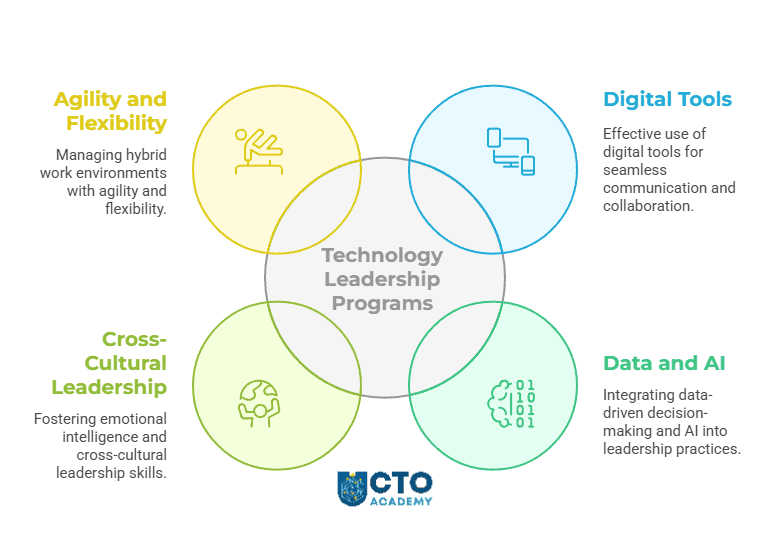
    But communication is just one out of the four main challenges of remote team leadership that technology leadership programs address:

    4 main challenges of remote work leadership solved by Tech MBA - visual presentation - mindmap

    1. Digital Communication and Collaboration Tools

    Don’t just use tools, utilise them. 

    Take CTO Academy for an example. The team is fully remote, operating from three continents. However, we seldom miss a deadline. That’s because team management is perfectly aligned with principles stemming from relevant modules and lectures of the specialised Tech MBA

    These lectures address the most prevalent challenges in remote communication and collaboration:

    • Lack of non-verbal cues
    • Communication overload
    • Misunderstanding/miscommunication
    • Lack of visual context
    • Accountability and monitoring

    In one of our recent peer-to-peer sessions, for instance, seasoned fractional CTO Stephen Morris emphasised the importance of frequent communication with distributed teams. He highlighted that a CTO’s role involves constant communication, as well as acting as a liaison, organiser and unblocker.  “I’d say I communicate almost daily with all the teams”, he explained, “because that’s what you do as a CTO”. 

    While this requires significant time, it’s crucial for effective leadership. As teams grow and become more distributed, the focus shifts towards managing team leaders rather than individual contributors.  “Obviously, you’re managing the team leaders rather than the individuals”, Morris added.  “Ultimately, the frequency and nature of communication depend on the size and structure of the team and the overall organisation”, he concluded.

    Tech MBAs equip you with the skills to leverage emerging technologies strategically. This includes streamlining remote operations through optimised workflows and automation. Furthermore, you’ll learn to choose the most effective communication channels for different situations. For example, utilise asynchronous tools for quick status updates but prioritise video conferencing for complex discussions.

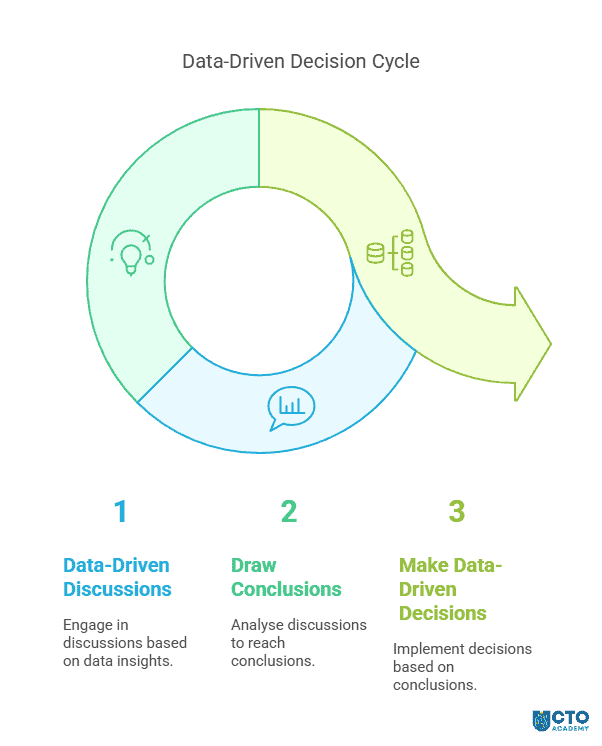
    This dialogue (discussions) must eventually produce operational decisions. But for any of that to be effective, it must be based on data. 

    Data-driven decision cycle - visual mind map of the process

    Data-Driven Decision-Making and AI Integration

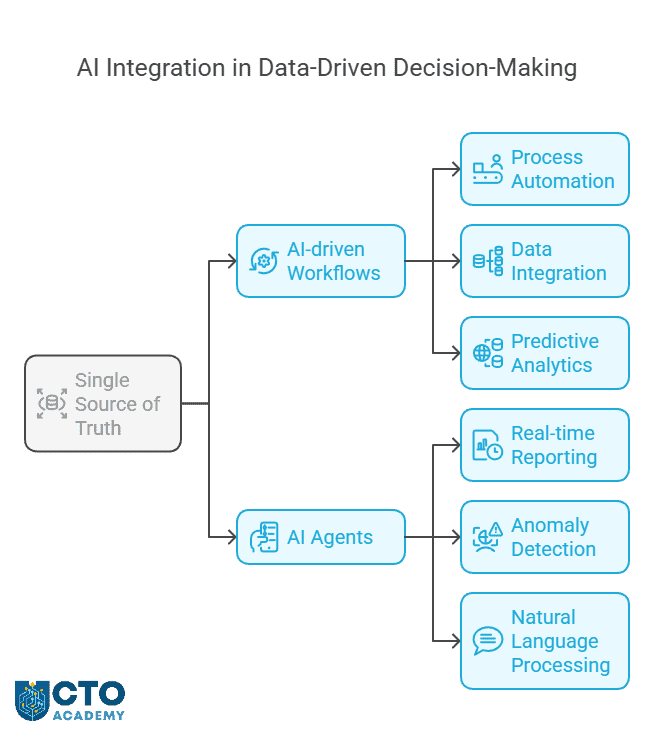
    Data-Driven Decision-Making and AI Integration - visual mind map of the components

    The effectiveness of distributed teams relies on well-organised centralised systems for communication, data gathering and processing. For example, team members must have seamless access to the central nervous system (a single source of truth) and the necessary analytical tools but, at the same time, leaders must be able to monitor productivity. 

    However, it’s not exactly a straightforward process.

    Firstly, to organise such a system, you need to possess extensive knowledge in operational data modelling, advanced analytics, data hierarchy and AI integration. Secondly, you need to know how to utilise the data in business decisions on the one hand and performance monitoring on the other; that is, understanding which data matter for which business operation including remote team management.

    This is exactly why the curricula of technology leadership programs go into detail about AI-powered data-driven business reasoning and the decision-making process itself.

    Unfortunately, AI-enhanced data and analytics can get you only so far because there is one critical trait AI and databases don’t possess and that’s emotional intelligence.   

    Emotional Intelligence

    In the office, subtle tell-tale signs that something is wrong with the team’s dynamics are easy to spot. In the remote setting, on the other hand, these sometimes subtle nonverbal cues are masked. 

    The Tech MBA curricula provide practical insights into empathy and emotional intelligence in the leadership context that enable leaders to spot these changes in a remote or hybrid work environment. Lectures cover critical topics such as:

    • Careful use of empathy tools
    • Open questions techniques in the context of cross-cultural team management
    • Active listening
    • Distinction between compassion and empathy

    However, they also examine the concept of “empathy in action”, outlining how to understand and help employees, appreciate different perspectives, engage in healthy debates and make recommendations for success. Often, this requires a healthy dose of flexibility.

    Agility and Flexibility in Hybrid Work Management

    Hybrid work management requires leaders who can seamlessly shift between remote and in-person work dynamics. That’s the reason why Tech MBAs emphasise:

    • Flexible work models that prioritise employee autonomy and well-being.
    • Case studies on successful remote-first companies to illustrate best practices in digital leadership.
    • Agile methodologies for iterative management and rapid problem-solving in hybrid work environments.

    Conclusion

    While remote work offers benefits like access to global talent pools, it also introduces unique leadership challenges. One of the biggest is balancing productivity demands with employee well-being. 

    Employee well-being is no longer just a topic of empirical studies; it’s a core demand of today’s workforce. This generation prioritises work-life balance, flexibility and mental health, marking a significant shift from the traditional job paradigm. Leaders must, therefore, adapt to these evolving expectations to attract and retain top talent in the remote work landscape.

    However, to achieve that, they (leaders) must obtain a new set of skills and the only place where they can learn them is the curriculum of technology leadership programs and Tech MBAs. 

  • How to Create a Robust and Flexible Decision-Making Framework

    How to Create a Robust and Flexible Decision-Making Framework

    It’s challenging to create a truly immutable decision-making framework, especially in dynamic environments with conflicting priorities. However, you can create a robust and adaptable framework that provides consistent guidance while allowing for flexibility when needed.

    Here’s a possible approach if you are managing two conflicting departments dependent on each other’s productivity (eg, CPTO role):

    1. Establish Clear Objectives and Metrics

    • Define overarching goals that both departments contribute to. This fosters a sense of common purpose and encourages collaboration.
    • Establish clear, measurable metrics for each department that align with the shared goals. This ensures accountability and clarifies expectations.
    • Identify metrics that reflect the interdependency between the departments. This could be on-time delivery, project completion rate or shared resource utilisation.

    2. Create a Decision-Making Process

    • Establish a regular meeting or communication channel where both departments can discuss issues, share updates and make joint decisions.
    • Encourage the use of data and objective analysis to inform decisions, reducing emotional bias and promoting fairness.
    • Define clear escalation paths for resolving disagreements, ensuring that conflicts are addressed promptly and effectively.

    3. Foster a Culture of Collaboration

    • Align reward systems and incentives to promote collaborative behaviour and recognise joint achievements.
    • Encourage open and transparent communication between departments, fostering trust and understanding.
    • Provide training on conflict resolution techniques to equip employees with the skills to manage disagreements constructively.

    4. Periodic Review and Adaptation

    • Conduct periodic reviews of the framework’s effectiveness, soliciting feedback from both departments.
    • Be prepared to adapt the framework as needed to accommodate changes in business objectives, organisational structure or external factors.

    Practical Application: Engineering & Product Development

    As a CPTO, you are leading both Engineering and Product Development teams. Product Development designs new features and products, while Engineering builds and implements them.

    • Shared Goal: Successfully launch innovative, high-quality products that meet market needs and achieve business objectives (eg, increased revenue, user growth).
    • Individual Metrics:
      • Product Development: Number of features designed, user stories defined, prototypes created.
      • Engineering: Velocity (features delivered per sprint), code quality, system uptime, bug resolution rate.
    • Interdependency Metric: Number of features successfully launched and deployed without major bugs or delays.
    • Decision-Making Process:
      • Weekly joint meetings to review product specifications, discuss technical feasibility, estimate development time and identify potential roadblocks.
      • Decisions are driven by data on development capacity, technical constraints, user feedback from previous releases and market research.
      • A clear escalation path is defined for resolving disagreements, involving a technical lead and a product manager.

    Scenario:

    Product Development proposes a complex new feature with a tight deadline. Engineering raises concerns about feasibility and potential impact on system stability.

    • Framework in Action: In the joint meeting, both teams present data: Product Development shows market demand and potential revenue impact, while Engineering presents data on current workload, technical challenges and estimated development time.
    • Outcome: Through collaborative discussion, they might decide to adjust the scope of the feature, extend the deadline or allocate additional resources to ensure successful implementation.

    As you can see, this framework fosters a collaborative environment where Engineering and Product Development work together effectively to achieve shared goals. It encourages data-driven decision-making, clear communication and proactive problem-solving.

    It is a kind of decision-making framework commonly utilised by Chief Product & Technology Officers but can be adjusted and applied to any intersection. 

  • Conflict Management in the Workplace

    Conflict Management in the Workplace

    In the tech industry, workplace conflicts are quite common. For instance, a study found that 85% of employees experience some form of conflict at work, with tech environments being particularly prone due to the high-pressure nature of the industry.

    One notable example is the frequent disputes over project strategies and technical disagreements. These conflicts, if not managed properly, can lead to a significant drop in productivity and morale. In fact, unresolved conflicts in IT teams can result in missed deadlines and project delays, ultimately affecting the overall performance of the team.

    Table of Contents

    The Concept of Conflict Management and Its Importance for CTOs and Senior Tech Leaders

    Conflict management is identifying and handling conflicts in a sensible, fair and efficient manner. 

    Conflicts can arise from a variety of sources, including technological challenges, resource allocation and interpersonal dynamics. 

    By resolving disagreements constructively, technology leaders can enhance team productivity and contribute to the overall health and performance of the organisation, leading to better decision-making, increased adaptability and sustained competitive advantage.

    Understanding Conflict

    What is Conflict From Both Positive and Negative Side?

    Conflict is, basically, any situation where there are opposing ideas, interests or forces. It is a natural part of human interaction that can arise in any context, from personal relationships to international relations. 

    While often perceived negatively, conflict also has positive aspects. It can catalyse change, innovation and growth, encouraging individuals and groups to re-evaluate their positions and find new, often improved, ways of doing things. 

    However, when left unresolved or managed poorly, it can lead to a breakdown in communication, damaged relationships and even violence. Thus, understanding the dynamics of conflict is essential for harnessing its potential benefits while mitigating its risks.

    Common Causes of Conflict in Tech Workplaces

    There are five main causes:

    1. Technical disagreements
    2. Deadlines and resource constraints
    3. Communication breakdowns
    4. Personality clashes

    Technical disagreements often occur when team members have divergent views on project strategies or technical solutions, reflecting the fast-paced and innovative nature of the industry. 

    Deadlines and resource constraints add another layer of stress, as teams must navigate the pressures of delivering complex projects within tight timeframes and often with limited resources. 

    Communication breakdowns are another critical trigger, where misinterpretations or lack of clarity can lead to misunderstandings and disputes. 

    Personality clashes stemming from diverse backgrounds can also contribute to tensions, as differences in work styles, values and expectations come to the fore. 

    Lastly, organisational change and restructuring represent a significant source of conflict, as they can disrupt established workflows and roles, leading to uncertainty and resistance among employees. 

    Managing these conflicts requires a proactive approach, focusing on clear communication, empathy and a willingness to find common ground to foster a collaborative and innovative work environment.

    The Cost of Unresolved Conflict

    Decreased productivity and morale are often the most immediate effects, as employees may become disengaged and less motivated to perform their duties effectively. 

    This disengagement can lead to increased employee turnover, which not only incurs costs associated with hiring and training new staff but also disrupts the continuity of knowledge and experience within the team. 

    Furthermore, ongoing conflict can severely damage relationships and team dynamics, creating a hostile work environment that stifles collaboration and communication. Such an atmosphere is detrimental to team spirit and can prevent the formation of strong, cohesive teams that are essential for achieving common goals. 

    Finally, unresolved conflict hinders innovation and growth, as it diverts energy away from creative problem-solving and strategic thinking, which are critical for adapting to market changes and seizing new opportunities. 

    Essential Conflict Management Skills for Tech Leaders

    Self-Awareness

    Self-awareness involves recognising one’s own emotional responses, communication style and behavioural patterns during conflict situations. 

    By understanding your personal conflict style, whether it’s avoiding, accommodating, competing, compromising or collaborating, you can anticipate reactions and adapt your approach to be more effective. 

    Additionally, being aware of personal triggers—specific words, actions or situations that may provoke a strong emotional response—allows you to maintain composure and think strategically during disputes. 

    This level of self-reflection not only helps in de-escalating potential conflicts but also in fostering a culture of open communication and mutual respect within the team. 

    Ultimately, self-awareness empowers you as a tech leader to transform conflict into a constructive dialogue, paving the way for innovative solutions and team growth.

    Active Listening

    Active listening, in the context of conflict resolution, involves fully concentrating, understanding, responding, and remembering what is being said. 

    This technique is not just about hearing the words, but also about understanding the complete message being conveyed. 

    Active listening allows leaders to grasp the nuances of the disagreement, showing respect and empathy towards the speaker, which can help de-escalate tensions. In other words, by actively listening, you can identify the underlying issues that are not explicitly stated, enabling you to address the root causes of the conflict rather than just the symptoms. 

    Furthermore, it fosters an environment where all parties feel heard and understood, which is essential for finding a mutually acceptable resolution. 

    Effective active listening in conflict situations also involves asking clarifying questions and paraphrasing back what has been said to ensure understanding, thereby facilitating a more open and productive dialogue.

    Empathy and Emotional Intelligence

    Empathy allows individuals to understand and share the feelings of others, fostering a sense of support and understanding

    Emotional intelligence, on the other hand, involves the ability to recognise, understand and manage one’s own emotions, as well as the emotions of others. 

    When you apply empathy and EI in conflict situations, you, effectively, facilitate a deeper comprehension of the underlying issues and emotions at play. This understanding is crucial because conflicts in the workplace are rarely just about the surface-level problem; they often stem from unaddressed emotional undercurrents such as fear, insecurity or frustration. By acknowledging these emotions, parties involved can move beyond mere transactional interactions and engage in meaningful dialogue that addresses the core of the conflict.

    Moreover, leaders who exhibit high levels of empathy and EI are better equipped to navigate the complexities of workplace disputes. They can create an environment where employees feel heard and valued, which can reduce the intensity of conflicts. Such leaders are also more adept at mediating disputes by guiding the conversation towards collaborative solutions rather than adversarial stand-offs. This approach not only resolves the immediate conflict but also builds a foundation for stronger relationships and a more cohesive team dynamic.

    In addition, empathy and EI contribute to a culture of open communication and trust, which are essential for innovation and creativity—key drivers in the tech industry. When team members feel emotionally safe, they are more likely to take risks and think outside the box, leading to breakthrough ideas and solutions. Thus, the value of empathy and EI extends beyond conflict management; it is integral to the overall success and competitiveness of a tech organisation.

    Therefore, the integration of empathy and emotional intelligence into conflict management leads to more effective resolution of conflicts, fosters a positive work environment and ultimately contributes to the innovative spirit that is at the heart of the technology sector.

    Communication Skills

    Clear communication ensures that all parties understand the issues at hand and the proposed solutions. In other words, being concise helps keep discussions focused and efficient, preventing misunderstandings that can escalate tensions. 

    Respectful communication fosters a positive environment where all team members feel valued and heard. This is crucial in tech teams where diverse perspectives drive innovation. 

    Problem-Solving and Negotiation

    A key strategy is to foster an environment where open communication is encouraged, allowing all parties to voice their concerns and perspectives. This sets the stage for understanding the root causes of conflicts. 

    Once these are identified, leaders can facilitate brainstorming sessions to generate a range of solutions, emphasising the importance of finding common ground. 

    It’s also beneficial to approach negotiations with a win-win mindset (flexible approach), seeking solutions that offer value to all involved rather than zero-sum outcomes. 

    Additionally, tech leaders should be adept at leveraging data and evidence to support their positions and proposals, which can help in reaching agreements that are based on objective criteria. 

    Mediation and Facilitation

    Tech leaders act as neutral facilitators to guide discussions towards a constructive resolution. 

    By employing active listening, asking open-ended questions, and encouraging empathy, tech leaders can help team members understand different viewpoints and find common ground. 

    Ultimately, they can use their technical expertise to clarify misunderstandings related to the work at hand. 

    Conflict Management Strategies

    The Five Conflict Management Styles (Thomas-Kilmann Model)

    The Thomas-Kilmann Conflict Management Model, developed by Kenneth W. Thomas and Ralph H. Kilmann, identifies five principal conflict management styles based on varying degrees of assertiveness and cooperativeness. These are:

    1. Avoiding
    2. Accommodating
    3. Competing
    4. Compromising
    5. Collaborating

    The first style, Avoiding, is low in both assertiveness and cooperativeness. It is predominantly used when the conflict is trivial or when the costs of confrontation outweigh the benefits. 

    Accommodating is the opposite, being unassertive but cooperative, ideal for when the issue matters more to the other party. 

    Competing is assertive and uncooperative, suitable for urgent situations requiring quick, decisive action. 

    Compromising finds the middle ground, with intermediate assertiveness and cooperativeness, and is apt when both parties’ goals are important but not worth the effort or potential disruption of more assertive means. 

    Lastly, Collaborating is both highly assertive and cooperative, seeking win-win solutions. It’s best for complex issues affecting multiple parties or requiring consensus. 

    These styles are not mutually exclusive and can be adapted depending on the situation, relationship and context of the conflict.

    Choosing the Right Strategy

    Selecting the most effective conflict management strategy requires a nuanced understanding of the specific situation and the individuals involved. 

    The first step is to identify the source of the conflict, which could range from miscommunication to differences in values or priorities. 

    Once the root cause is understood, it’s essential to determine the conflict management style that best suits the scenario. 

    As we explained earlier, there are five primary styles: competing, accommodating, avoiding, collaborating, and compromising. 

    Each has its strengths and weaknesses, and their effectiveness can vary depending on the context and the relationship between the parties involved. 

    For instance, a competing style may be necessary when quick, decisive action is needed, while a collaborating approach could be more appropriate for complex issues requiring a win-win solution. 

    It’s also crucial to consider the potential consequences of each strategy and to assess which approach aligns with the desired outcome. 

    The goal is to foster a resolution that respects the inherent dignity of each individual and promotes a productive and harmonious environment.

    Practical Tips for Managing Conflict

    • Establishing clear ground rules for conflict resolution provides a framework that encourages fair and consistent handling of disputes. 
    • Addressing conflicts early and directly can prevent escalation and foster a culture of transparency. 
    • Creating a safe space for open communication allows team members to express concerns without fear of retribution, leading to more genuine and productive dialogues. 
    • Focusing on interests rather than positions helps in identifying the underlying needs and desires, which can lead to more sustainable and agreeable solutions. 
    • Seeking win-win solutions reinforces a collaborative approach, ensuring that all parties feel heard and valued. 
    • Documenting agreements and follow-up actions creates accountability and clarity, ensuring that resolutions are implemented effectively. 

    Conflict Prevention

    Building a Positive Workplace Culture

    Company culture plays a pivotal role in shaping the dynamics of workplace interactions and is instrumental in fostering collaboration and minimising conflict. A positive company culture that emphasises open communication, mutual respect and collaboration can create an environment where employees feel valued and supported. 

    This, in turn, encourages them to engage constructively with their colleagues, leading to enhanced teamwork and productivity. 

    When conflicts do arise, a strong company culture provides a framework for effective resolution strategies that are perceived as fair and transparent, thereby maintaining trust and morale. Moreover, a culture that views conflicts as opportunities for growth and learning can transform potential challenges into catalysts for innovation and development. 

    After all, a thriving company culture not only attracts and retains top talent but also contributes to a positive reputation, which is essential for long-term organisational success.

    Proactive Communication and Collaboration

    • Establishing clear expectations from the outset can significantly reduce misunderstandings and foster a cooperative environment. 
    • Open communication channels ensure that all parties can voice their concerns and suggestions, which can be addressed in a timely and effective manner. 
    • Regular feedback loops contribute to a dynamic where continuous improvement is encouraged, and issues can be resolved before they escalate into conflicts. 

    This proactive approach not only prevents potential disputes but also builds a strong foundation for a resilient and adaptive team dynamic.

    Team Building and Training

    These initiatives foster a sense of unity and understanding among team members, enabling them to work more cohesively towards common goals. 

    Team-building exercises, for instance, can help individuals recognise the strengths and weaknesses of their colleagues, leading to better collaboration and a more harmonious work environment. 

    Conflict management training equips employees with the necessary tools to handle disputes effectively, ensuring that they can be resolved in a way that is constructive rather than destructive. 

    Conflict Resolution Systems

    Mediation, for instance, involves a neutral third party who facilitates a dialogue between disputing parties to help them reach a mutually acceptable agreement. The mediator does not impose a solution but rather assists the parties in understanding each other’s perspectives and finding common ground. 

    Ombudsman programs provide a similar service, with an ombudsman acting as an independent, impartial figure who can investigate complaints, recommend solutions and mediate disputes, often within organisational settings.

    These systems address conflicts in a structured manner, aiming to resolve them before they escalate. They offer a confidential and often less adversarial alternative to litigation, which can be costly and time-consuming. By focusing on collaboration and understanding, formal conflict resolution mechanisms can lead to more sustainable and satisfactory outcomes for all involved parties.

    In the workplace, for example, the implementation of such systems can significantly reduce the incidence of conflicts and improve the overall work environment. According to Harvard Business School, effective conflict resolution is crucial for maintaining a productive work atmosphere and can save organizations considerable amounts of time and money that would otherwise be lost to unresolved disputes. 

    Moreover, the Program on Negotiation at Harvard Law School highlights the importance of managing conflict through resolution strategies that avoid litigation, emphasising negotiation, mediation and arbitration as the primary methods. 

    Case Studies

    Real-World Examples

    Conflict management is a critical aspect of organisational behaviour, particularly in the fast-paced and often high-stakes environment of technology companies. A notable example of successful conflict resolution is the case between Apple and Samsung, two tech giants who found themselves in a heated patent dispute. 

    The negotiation process, which involved high-level meetings between CEOs and mediation attempts, although initially unsuccessful, eventually led to a resolution that allowed both companies to continue their business relationship. This case study highlights the importance of willingness to compromise and the impact of strategic negotiation on preserving business partnerships.

    Another instructive case is the fictional scenario by Harvard Business Review, where the CEO of a sports apparel company grapples with resolving a conflict between two senior executives. 

    The resolution strategies discussed include altering the company’s compensation scheme to foster collaboration, engaging in team-building activities and providing executive coaching. This case underscores the ripple effect that unresolved conflicts can have on team dynamics and the broader organisational climate.

    Furthermore, there is a growing role of Information and Communication Technologies (ICTs) in transforming conflict dynamics and peacebuilding activities. Case studies at various levels have shown how ICTs can change the landscape of conflict management, offering new tools and platforms for dialogue and resolution.

    Key Takeaways (from studies)

    A common theme across various studies is the importance of active listening and empathy, which are essential for understanding the root causes of conflicts and for developing a constructive dialogue. 

    Additionally, promoting self-awareness among team members can prevent many conflicts from arising by encouraging individuals to reflect on their behaviour and its impact on others.

    These case studies highlight the benefits of integrating conflict resolution skills into leadership training, such as reduced project turnaround times, decreased turnover rates and improved team dynamics. For instance, tech leaders who are adept at conflict resolution can harness disagreements as opportunities for creative problem-solving and building trust within teams. This approach not only resolves the immediate issue but also strengthens the team’s ability to handle future challenges collaboratively.

    Moreover, the implementation of practical exercises like role-playing and case studies during leadership training has proven effective in embedding these skills. Such hands-on experiences prepare leaders not just to manage conflicts when they arise but also to anticipate and mitigate potential disputes before they escalate. The emphasis on actionable learning experiences resonates with the unique challenges tech leaders face, equipping them with the tools to manage human dynamics alongside technological innovations.

    Another key takeaway is the significance of structured processes in mitigating issues. Tech teams that follow clear protocols for conflict resolution spend less time dealing with disputes, which directly impacts productivity positively. Leadership plays a pivotal role in establishing and enforcing these processes, ensuring that all team members are aware of the steps to take when conflicts arise.

    Conclusion

    As a technology leader, you will often find yourself in the role of a mediator. It can be a team dispute or even cross-organisational. In both instances, parties involved in a conflict will expect a resolution from you. 

    What you must understand is that your proposed solution does not have to be beneficial to either of the conflicted parties. Instead, you can propose an entirely new reality and initiate a debate by seeking individual opinions to assess the level of confusion. 

    If you logically present your solution using facts as arguments, it will reduce the level of confusion and facilitate acceptance of your proposal. 

    Just remember that everything you say before the word “because” is, effectively, a command. What comes after “because”, provides a contextual elaboration of your decision. 

    Therefore, every time you offer a solution, provide a complete context. In other words, explain the “why”.

  • Self-Leadership is Key – MBA Lecture Summary

    Self-Leadership is Key – MBA Lecture Summary

    In this article — effectively a summary of the lecture in our Digital MBA for Technology LeadersAndrew Bryant, business coach and public speaker whose book on this subject is used in MBA programs worldwide, explains what self-leadership is, why you need it and how to develop it.

    What is Self-Leadership?

    Self-leadership is the practice of intentionally influencing your thinking, feelings and actions towards your objectives. For some, this comes naturally, while others have to train themselves in it.

    The problem the latter group needs to solve first is the so-called, framing or the nature of an individual’s central belief system that’s been influenced by social and physical factors. Framing effectively influences the way we see the world and, therefore, affects our decision-making process.

    So the first step to solve this is to step back from that frame and accept the fact that we have all been pre-programmed. Otherwise, you will continue being just a passenger on the bus of life, as Andrew put it in his lecture.

    Are You Capable of Self-Leadership?

    One of the ways to check that is to confirm the potential absence of self-leadership abilities.

    How to recognize the absence of self-leadership?

    If a person has tendencies for reactivity, randomness, blame and a victim mindset, then it’s safe to say that self-leadership voids.

    Why is Self-Leadership Important?

    A) To become the driver of that bus of life and, thus, take full control of your actions and reactions.

    B) To avoid the aforementioned symptoms that indicate the acute or chronic absence of self-leadership abilities.

    The maxim here is, therefore, that you can’t lead others unless you first lead yourself.

    This brings us to our final and most important part of this lecture:

    How to Develop Self-Leadership Skills?

    To test the ability to self-lead, we first need to measure self-awareness, self-regulation and self-learning.

    As you know, self-awareness is the tendency of an individual to focus and reflect on psychological processes, inner experiences and relationships with others.

    Let’s do a quick psychometric test on you right now.

    Psychometric Test of Self-Awareness

    A chessboard with pieces where each piece represent a specific work personality relative to the role of the piece in the game of chess. It gives a clue whether a person has self-leadership abilities.

    Now, choose a chess piece that best represents your professional (work) personality.

    Let’s see what each piece means.

    PAWN: Eight on each side, they move slowly towards the opposition and are likely to be sacrificed early in the game. If you are feeling powerless at work, you’d be a pawn.

    ROOK: A risk-averse piece that doesn’t move early in the game. Audit or compliance and sometimes technology are in the rook category. It is a very powerful, but not necessarily a good position early in the game.

    KNIGHT: This is a risk-embracing piece, an entrepreneur. Jumps forward, sideways, surprises the enemy. The problem is that, sometimes, knights get so far ahead of the other pieces that they lack the support.

    BISHOP: A piece that cuts diagonally across the board. Always in a hurry, hates stand-up operating procedures and just wants to sell even before R&D develops a product or Operations come up with the delivery process. Bishop is also the arch-enemy of the rook.

    QUEEN: In the original Indian game of chess, the queen was the vizier and wasn’t gender-specific. The queen can go forward, backwards and diagonally. In other words, she can go everywhere. However, she’s so busy looking after everybody else that she sometimes forgets to look after herself.

    KING: If you chose the king, maybe you have delusions of grandeur and narcissistic tendencies because the king, whilst the most important piece on the board, requires the support of all other team members.

    And now for the real kicker – it doesn’t matter which piece you chose. This was a setup because you’ve been framed.

    The real lesson here is to have a high level of self-awareness to step back from stereotypes and play all the pieces.

    Building a high level of self-awareness is critical for the next fundamental – self-learning.

    What is Self-Learning?

    Self-learning is the process by which individuals take the initiative in diagnosing their learning needs, goals, resources and outcomes.

    Our students, for instance, have already demonstrated an intention for self-learning simply by enrolling and following the lectures. That’s why you need to apply self-leadership to all the things that you learn here or anywhere else, adjust your behaviour and move forward.

    In chess, for example, you will often find yourself cornered and locked up. But a self-leading mindset perceives such a situation differently simply because it is aware that when we feel stuck, there’s an opportunity lying in there somewhere. So if you just stick for a moment and take a good look at the board, you’ll find an opportunity to not just get out of the trap but to turn the game around. In other words, your self-learning tendencies will start looking for options.

    From those options, we move into self-regulating mode, otherwise known as, self-management.

    A self-regulatory process modulates attention, emotion and behaviour for a given situation/stimulus with the underlying purpose of pursuing a goal. Self-regulation, therefore, allows us to find the opportunities.

    In other words, with self-regulation, we can take action when opportunities arise.

    There are various things we can do to track our self-regulation but one of the most effective is to set up our work environment to trigger us into our best state to do the work that we need to do. It can be time management, focus or better organisation.  

    The Big Picture

    The big picture here is to set an intention to see the frames (options) to set your own frame (opportunity).

    You see, at the C-level, you are not taking orders anymore or acting reactive. Instead, you are proactive, strategic and part of the senior leadership team (SLT) – the single most important team in every organisation.

    So you must articulate your intentions, ideas and insights. In other words, you must use self-leadership to convert those into executive presence; the ability to project gravitas, confidence and poise under pressure. When you do that, you develop the so-called, influence capital.

    Conclusion

    Self-leadership is the foundation. It leads to options and opportunities. And it has only three principles:

    1. Always look for options and opportunities.
    2. Be self-aware to assess the nature of the frame you’re operating from.
    3. Learn to take and process feedback and make necessary adjustments.

    And here is a good quote you should remember:

    “Everything can be taken from a man, but one thing, the last of the human freedoms, to choose one’s attitude in any given set of circumstances to choose one’s own way.”

    Dr. Victor Frankl

    Self-leadership is that inner resilience. It is the flexibility to find the course by choosing your frame rather than accepting the frames of your birth and upbringing.

    Remember, it doesn’t matter what has happened in the past because when you change your intention, you change your future.

  • Role of Perception in Leadership and How to Change It

    Role of Perception in Leadership and How to Change It

    How often have you asked yourself, “How could my partner, colleague, or employee have misread my intended communication so badly?” This MBA lecture summary provides the answers, strategies and suggestions for changing other people’s perception of you as a leader and person.

    We all live in a constant duality between how we see ourselves and how others see us. That’s why we require social validation of our actions and responses.

    But there’s another dimension that further deepens the problem.

    The Perception Gap

    We suffer from the gap between perception and reality. That is, individually, we perceive certain things and people (very) differently. The problem with the business side of that issue is that employees will evaluate you as a leader based on their perception of your abilities and performance and not yours.

    So to even begin working toward the solution, we must first understand the key attributes of a successful leader and how perception –which is absolutely subjective and individual — influences your success.

    The Key Attributes of a Successful Leader

    • Technical Skills

    These are given.

    • Strategic Vision

    Or where do they think you’re leading them.

    • Interpersonal Skills

    Acknowledging and understanding how perceptions affect your relationships with other people, and therefore your ability to lead.

    That said, the ability to understand and influence perception is particularly important in interpersonal skills. To be an effective leader, you must realise that no two people perceive things the same way simply because they judge based on what they see.

    In other words, your team and colleagues build their reality based on background thoughts and sense of the world. Anything that doesn’t fit into this reality can be quickly dismissed, ignored or misconstrued. On the other hand, elements that might support personal vision will be greatly used to reinforce it.

    The problem is that the generated perception influences our/their behaviour and, therefore, performance.

    Factors That Influence Perception

    • Habit
    • Motivation
    • Learning
    • Specialisation
    • Social Background

    Ingrained habits create a mental framework through which we filter incoming information, often leading to selective perception based on familiarity. For example, a coffee lover might perceive the aroma of coffee brewing in a cafe before others who don’t regularly drink it.

    RECOMMENDED READING: Charles Duhigg, “Power of Habits: Why We Do What We Do in Life and Business

    Our desires and needs (motivation), can alter our focus and interpretation, making us more likely to notice and value things that align with our goals. The analogy is a hungry person who might see food-related items in a shop more readily than a satiated individual.

    Everything we learn (ie, prior knowledge and experience) up until the moment in which we are constructing our perception of something shapes our understanding, providing a context through which we interpret new stimuli. For instance, a botanist might recognise a rare plant species while hiking, while others might only see generic greenery.

    Expertise in a particular field can lead to a more nuanced and detailed perception within that domain, while potentially overlooking broader aspects. A software engineer might quickly identify a bug in a program that others wouldn’t notice.

    Finally, our cultural upbringing and social interactions instil values and beliefs that colour our interpretations of the world. For example, a person from a collectivist culture might perceive a group project as more important than individual tasks, compared to someone from an individualistic culture.

    RECOMMENDED READING: Daniel Kahneman, “Thinking, Fast and Slow”

    Let’s now import these factors into our team and see what happens.

    Case Study: Team’s Perception of Their Common Leader

    Imagine a team of five engineers and assign a single dominant factor we discussed to each. How exactly will they perceive you as their leader? What would a general (common) perception of that leader be?

    Individual constructs

    1. Engineer 1 (Habit): This engineer, accustomed to a particular leadership style from past experiences, might perceive the leader based on how closely they resemble those familiar traits. If the leader deviates significantly, Engineer 1 might have difficulty adapting their perception.
    2. Engineer 2 (Motivation): Driven by career advancement, Engineer 2 might view the leader as a stepping stone. They’ll perceive the leader’s actions through the lens of how those actions can benefit their career trajectory.
    3. Engineer 3 (Learning): This engineer, always eager to learn, might perceive the leader as a mentor. They’ll closely observe the leader’s decision-making processes, technical skills, and leadership style, seeking opportunities to learn and grow.
    4. Engineer 4 (Specialisation): Highly specialised in a particular technology, Engineer 4 might perceive the leader based on their technical competence in that specific area. They might respect the leader if they demonstrate deep knowledge, but might be critical if they perceive a lack of expertise.
    5. Engineer 5 (Social Background): Coming from a culture that, for instance, values collaboration and consensus, Engineer 5 might perceive the leader based on how well they foster teamwork and inclusivity. They might appreciate a leader who encourages open communication and values everyone’s input.

    General Perception

    The general perception of the leader would, of course, be a blend of these individual perspectives. However, it would be influenced by the dominant (global) factor within the team. For instance, if the team leans towards learning and collaboration, they might generally perceive the leader as a mentor and facilitator. If, on the other hand, career advancement and individual specialisation are more prevalent, the leader might be viewed more as a means to an end.

    How to Bridge the Gap between Perception and Reality

    Getting honest feedback — and let’s be honest about it — can be a little bit like hearing your own voice. It’s not always a comfortable experience, but it can provide enlightenment. This, in turn, allows you to gauge what those around you view as their reality.

    The feedback process protects you from erroneous perceptions. You’ll be perceived as someone with empathy who always considers different points of view.

    But the path from point A to point B is neither quick nor easy.

    Remember though that if you don’t know how you perceive, you can’t change things.

    So one way or another, you have to become open to constructive criticism. It will ensure that your leadership actions match your words.

    However…

    When you receive feedback, it will most likely oppose your self-perception. Consequently, you’ll feel mental stress. But should you accept the prevailing opinion, no matter how bitter it tastes, you will inevitably:

    1. Keep seeking fresh feedback.
    2. Start to communicate your own thinking process and motivations more openly.
    3. Adopt a more of a consensus-based approach to others.

    Cumulatively, the perception will slowly turn into reality.

    How to Change People’s Perception

    The science of persuasion and influence generally revolves around two questions:

    1. How does our behaviour influence the behaviour of others?
    2. How does other people’s behaviour influence our behaviour?

    Therefore, a simple step to gain more influence over an individual is, for example, the use of mirroring.

    When you mirror someone’s body language and words, the other person automatically becomes more engaging because a) they feel you trust what they say and b) you’re interested in their opinion.

  • How to Set Up and Run a Productive Meeting

    How to Set Up and Run a Productive Meeting

    “You have a meeting to make a decision, not to decide on a question”.

    Bill Gates

    Meetings can easily become an onerous element of any leader. When they’re scheduled back-to-back, they a) consume more time than you thought they would and b) don’t solve a thing.

    With this article, we want to ensure that, if a meeting is needed, you have the exact tools to make it productive, engaging and, finally, get the work done while the meeting is on.

    The Key Learning Points

    1. How to prevent cognitive overload and improve information retention.
    2. Ensuring inclusiveness.
    3. Creating an engaging environment.
    4. Asynchronous work and the mindset needed for productive teamwork.

    The Harvard Business Review found it’s too hard for humans to say no to a meeting invite. Some of the reasons are the now infamous FOMO and the false belief that everything is urgent.

    Now, we all know that extroverts enjoy interaction while introverts would rather avoid meetings altogether. In both instances, however, the event can cause cognitive overload.

    Preventing Cognitive Overload and Improving Retention of Information

    It happens when a meeting triggers stress and anxiety. For example, a technical meeting that requires extra concentration from attendees.

    The key here is to avoid overwhelming people with too much, too quickly.

    Always remember that some people in the meeting don’t have a technical background so go easy with the tech jargon.

    Never assume knowledge. Never make it harder than it needs to be for the people in the room. Instead, use metaphors and analogies to bridge that gap.

    Next, be clear about the structure and agenda of the meeting so people know what to expect.

    During the meeting, pay close attention to the speed at which you deliver points. In other words, give people the necessary time to digest and process information so they can better retain it.

    And, whenever possible, deliver content with a hands-on activity because it improves learning and personal connections between the people.

    Also, debrief during and at the end of every topic (and meeting) to ensure that everybody is a) engaged and b) understands. Ask open-ended questions like, “What particularly excites you from today’s meeting and is there something that worries you?”

    What to do if an attendee zoned out?

    • Throw in a fun question to distract people or bring attention back.
    • Make them move.
    • Change the tempo.

    Inclusiveness

    Our brains register exclusion the same way they register physical pain. And without that sense of belonging, fear and anxiety kick in. Consequently, we shut down.

    So, to increase inclusions in meetings, allow all participants an equal opportunity to participate and contribute.

    But for that to happen, you must create a safe environment where everybody feels comfortable to speak and be heard.

    There is, however, a slight problem with this. You see, what extroverts perceive as a safe environment, introverts may not.

    Timothy Clark, founder and CEO of Leader Factor and a recognised expert in psychological safety found that introverts, particularly women, have the worst time during meetings.

    Unlike extroverts, introverts need time to absorb information and reflect on questions. To tackle this, distribute the meeting agendas in advance.

    Introverts also shy away from verbal processing and prefer to crystallise their thinking before vocalising it. In other words, they like a finished product.

    And since they experience fatigue rather quickly, you should hold shorter meetings.

    Creating an Engaging Environment

    • Use tools.
    • Run a creative sprint, different from daily stand-ups or retros.
    • Do one-on-one walking
    • Use specialised apps (eg, SpatialChat, Gather…)

    Asynchronous Work and Required Mindset

    “The longer the meeting, the less is accomplished”.

    Tim Cook

    Lately, a lot of workplaces are adopting asynchronous work. A good example is GitLab. According to them, the easiest way to enter into an asynchronous mindset is to ask this simple question:

    How would I deliver this message, present this work or move this project forward right now if no one else on my team or in my company were awake?

    If the answer is, “I must wake everybody up”, then it’s fair to call a meeting.

    Maintaining a Productive Meeting

    • Leave as much as possible for asynchronous collaboration outside the meeting.
    • Assign duties at the end of it (if you fail to do it, the meeting is pointless).
    • Assign a supervisor (to track and report deliveries).
    • Follow up on items you didn’t cover and revisit each in the next meeting.
    • You don’t have to lead every meeting (remember inclusiveness).

    In Module 1 of our Digital MBA for Technology Leaders (Leadership and Team Building), expert lecturers break down the meeting issues in detail and provide actionable solutions to each problem. We briefly went over a few of them here, but that was just the tip of the iceberg. For example, how to identify introverts/extroverts or how to assign specific tasks and to whom.

    Remember, meetings are, effectively, problem-solving sessions, and it is imperative to understand every aspect of them to, ultimately, make them productive.

  • Responsibilities, Strategies and Necessary Skills of an Effective Technical Leader

    Responsibilities, Strategies and Necessary Skills of an Effective Technical Leader

    technical leader bridges the gap between technical teams and business objectives. Unlike general managers, they possess strong technical expertise and can therefore guide engineers and developers. In contrast to tech specialists, however, they have strong leadership and communication skills.

    But we need to distinguish the two roles here: Technical Leader and Tech Lead. While differences can be blurry in some instances (depending on the company size and stage of development), they commonly differ in the scope of the work and focus.

    Tech Leads

    Tech Leads are often individual contributors in a specific technical domain or project. They provide technical guidance to their team members and have more hands-on responsibilities (eg, coding, problem-solving, code reviews…) but within their area of expertise.

    Technical Leaders

    A Technical Leader, on the other hand, has a broader scope, overseeing the technical direction of a larger team or even multiple projects. They are responsible for the overall technical strategy and architecture decisions. While they might still possess strong technical skills, their role involves more leadership, mentorship and communication with both technical and non-technical stakeholders.

    Differences Between Technical Leader and Chief Technology Officer Roles – Technical Leadership vs Management

    The best way to understand the difference is through a simple analogy of a large and complex construction site.

    The Technical Leader is like the foreman, responsible for the quality and efficiency of multiple crews (eg, framing, plumbing and electrical). They ensure all these teams work together cohesively, adhering to the overall construction plan while maintaining quality standards. Technical Leaders manage the project schedule, address any roadblocks and communicate progress updates to the project manager.

    The CTO, on the other hand, is like the architect who designed the entire building project and oversees its overall execution. They have a vision for the entire complex, ensuring the design aligns with the intended purpose, functionality and budget.

    CTOs work more closely with the client (the owner) to understand their needs and translate them into a technical blueprint for the project. They might also be responsible for sourcing new materials or technologies (like innovative roofing solutions) to ensure the project’s success. Finally, they collaborate with the project manager (a general contractor who oversees day-to-day operations) to ensure the vision is translated into reality on-site.

    In this analogy, the Tech Lead would be, for example, a skilled carpenter leading a team of framers. They are experts in their specific area (framing) and ensure their team builds high-quality walls according to the blueprints.

    In summary, a Technical Leader is typically a mid-level to a senior management position within a specific technical department (eg, software development, data science). The focus is on the technical direction and execution within a specific team or project. They report to a higher-level manager, such as a Director of Engineering.

    A CTO, on the other hand, is a C-suite executive who reports directly to the CEO. They are a part of the strategic decision-making team responsible for aligning technology with business goals, evaluating and implementing new technologies, managing IT infrastructure and ensuring the security and compliance of all technical systems. These responsibilities may span the entire organisation and involve multiple technical departments.

    Now that we understand where the Technical Leader fits in the overall organisational structure, let’s take a closer look at the responsibilities and, more importantly, practical strategies deployed by effective TLs on day-to-day, project-based and long-term bases. In the process, we will develop a perfect understanding of a technical leader job description not limited to the tech industry alone.

    Responsibilities and Optimal Strategies Employed by Effective Technical Leaders

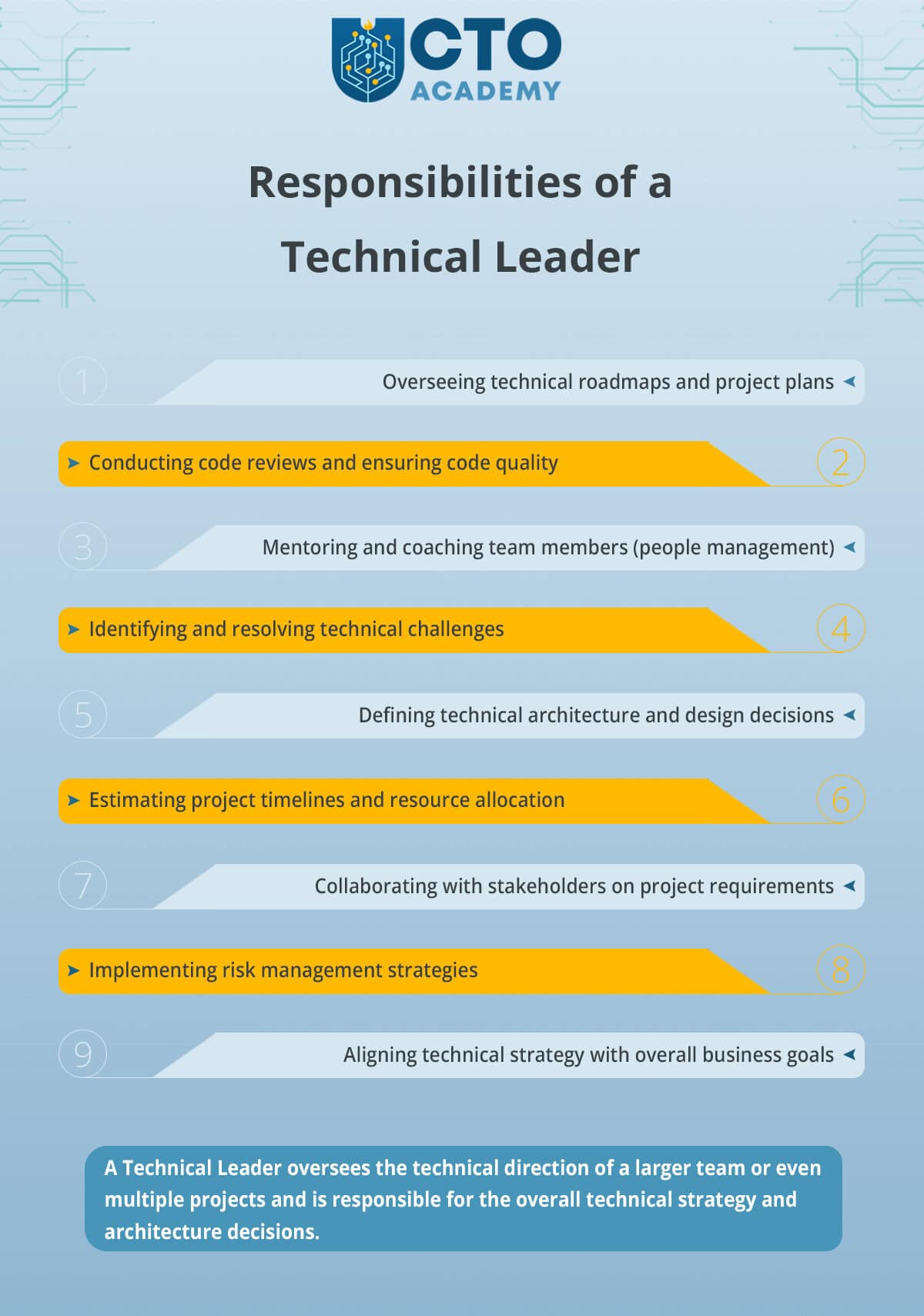
    The list of common responsibilities of a Technical Leader
    The list of common responsibilities of a Technical Leader (click to enlarge or download)

    1 Day-to-Day Operations

    1.1 Overseeing technical roadmaps and project plans

    1.1.1 Strategic Alignment

    • Ensuring the technical roadmap aligns with the overall business strategy by translating business goals into achievable technical milestones and features.
    • Prioritising projects and features based on their impact on business objectives. To do this, we must consider factors like market needs, resource availability and technical feasibility.

    1.1.2 Roadmap Management

    • Communicating a roadmap to technical and non-technical stakeholders. (This fosters transparency and ensures everyone understands the direction and priorities.)
    • Adjusting a roadmap based on market changes, technological advancements or unforeseen challenges (ie, being highly adaptable).

    1.1.3 Project Plan Oversight

    • Breaking down roadmap goals in collaboration with project managers and team leads. We want to end up with smaller actionable project plans.
    • Monitoring progress against the plan and addressing roadblocks or deviations from timelines and resource allocation.
    • Identifying and mitigating potential risks that could derail projects or delay the roadmap.

    1.1.4 Empowering Teams

    • Delegating tasks and responsibilities according to the project plan.
    • Empowering team members to take ownership of their roles while ensuring accountability.
    • Providing technical guidance and support to the team.
    • Encouraging knowledge sharing while fostering collaboration and problem-solving capabilities.

    1.1.5 Continuous Improvement

    • Conducting regular reviews of the roadmap and project plans while incorporating feedback from stakeholders and the team.
    • Analysing past projects to identify areas for improvement in future planning and execution.
    • Staying in the loop with emerging technologies and assessing their potential impact on the roadmap and project plans.

    1.2 Conducting code reviews and ensuring code quality

    1.2.1 Defining Guidelines and Enticing Collaborative Learning

    • Establishing clear coding guidelines and best practices that developers should follow to have a consistent framework for code reviews on the one hand and reduce subjectivity on the other.
    • Encouraging reviewers to focus on specific areas for improvement, such as code structure, logic flow or variable naming to provide actionable feedback for the author.
    • Conducting high-quality code reviews to demonstrate the importance they place on the process.
    • Focusing on improvement, not just bugs (ie, viewing code reviews as opportunities to foster a constructive environment where code authors and reviewers can learn from each other).
    • Emphasising code maintainability, readability and adherence to coding standards.

    Always remember that clear, well-documented code is easier to understand, modify and debug in the future.

    1.2.2 Leveraging Tools

    • Utilising static code analysis tools to automate the detection of common coding errors and potential vulnerabilities (frees up time for reviewers to focus on more complex issues and code style).
    • Ensuring the team leverages version control systems effectively to track code changes and facilitate collaboration during code reviews.

    1.2.3 Promoting a Culture of Quality, Reinforcement and Upskilling

    • Fostering an environment where developers feel comfortable asking questions and receiving feedback on their code.
    • Recognising developers who consistently write high-quality code to motivate the team and, thus, maintain and improve coding standards.
    • Identifying areas where developers might need improvement and providing mentorship or resources to enhance their coding skills.

    1.2.4 Prioritisation and Delegation

    • Prioritising code reviews based on potential impact and urgency (triaging) and delegating less critical reviews to senior developers while personally reviewing complex or high-risk code changes.
    • Focusing on high-impact areas rather than reviewing every single line of code (ie, codebase, core functionalities and/or areas prone to errors).

    1.3 Mentoring and coaching team members (people management)

    1.3.1 Building Relationships and Understanding Needs

    • Scheduling regular one-on-one meetings with team members to discuss career goals, challenges and opportunities (fosters open communication and allows the leader to customise approach to individual needs).
    • Encouraging team members to express their concerns and aspirations.
    • Active listening and providing constructive yet specific feedback.
    • Understanding individual learning styles (eg, hands-on learning tasks vs. textual/video tutorials.

    1.3.2 Creating a Supportive Learning Environment

    • Setting clear expectations for learning and development within the role.
    • Collaborating with team members to define specific developmental goals that align with their career aspirations and the team’s needs.
    • Providing resources and opportunities (eg, access to relevant training resources, creating opportunities for team members to apply their new skills on real-world projects…).
    • Focusing on psychological safety (ie, the environment where team members feel comfortable asking questions, making mistakes and trying new things without fear of judgment).

    1.3.3 Guiding and Empowering Growth

    • Providing opportunities for team members to take on challenging tasks outside their comfort zone while ensuring proper support and guidance (helps them develop new skills and gain confidence in their abilities).
    • Demonstrating commitment to continuous learning by actively learning new skills yourself and sharing your experiences with the team.
    • Enhancing problem-solving skills and decision-making capabilities by delegating tasks and demanding ownership.

    1.3.4 Continuous Feedback and Improvement:

    • Establishing regular feedback loops (eg, informal check-ins, code reviews, project post-mortems…)
    • Being flexible and adapting the coaching approach based on individual needs and progress.
    • Encouraging knowledge-sharing sessions, hackathons and code review sessions where team members can learn from each other.

    1.4 Identifying and resolving technical challenges

    1.4.1 Proactive Problem Identification

    • Anticipating risks and problems by encouraging a culture of proactive thinking within the team and open discussions of potential roadblocks, technical dependencies and emerging trends that could lead to future challenges.
    • Utilising monitoring tools and performance metrics to identify potential issues early on.
    • Creating an inside ticket system where team members raise concerns and report bugs, potential performance bottlenecks or security vulnerabilities.

    1.4.2 Structured Problem-Solving Approach

    • Defining the immediate challenge after identifying the problem (analysis of symptoms, error messages and user experiences).
    • Using techniques like root cause analysis to delve deeper and identify the underlying cause of the technical challenge
    • Encouraging collaborative brainstorming to explore potential solutions.
    • Ensuring that everyone is working on the same problem.

    1.4.3 Effective Resolution and Implementation

    • Evaluating the potential solutions based on factors like feasibility, impact, resource requirements and risk.
    • Prioritising solutions based on urgency and potential impact on the project or system.
    • Developing the implementation plan.
    • Communicating the problem, solution and implementation plan with all relevant stakeholders.
    • Documenting the process (and lessons learned!) to prevent similar issues in the future.

    1.4.4 Continuous Improvement

    • Scheduling post-mortem sessions after resolving a critical challenge.
    • Encouraging knowledge sharing.
    • Adapting to change.

    2 Project-based

    2.1 Defining technical architecture and design decisions

    STEP 1: Understand Business Needs

    • Align the technical architecture with the overall business goals and objectives (consider factors like scalability, security, performance and cost-effectiveness).
    • Gather stakeholder input (eg, product, sales, marketing) to understand needs, challenges and future expectations so that the architecture caters to diverse user needs.

    STEP 2: Evaluate Technologies

    • Consider factors like maturity, adoption rate, community support and integration capabilities with existing systems.
    • Foresee trends and potential growth to future-proof your decisions. In other words, choose solutions that are scalable, adaptable and can accommodate future changes in user base, data volume or technological advancements.

    STEP 3: Involve the Team

    • Involve key team members (eg, senior developers and architects) in the design decision process (!fosters a sense of ownership).
    • Once decisions are made, effectively communicate the chosen architecture and design patterns to the entire team so that everyone understands the rationale behind the decisions and can implement them consistently.

    STEP 4: Identify and Mitigate Risks

    • Engage in scenario planning and threat modelling (consider factors like security breaches, system outages, data loss, scalability limitations and single points of failure).
    • Develop mitigation strategies beforehand (eg, implement redundant systems, robust security measures and contingency plans for disaster recovery).
    • Develop proof-of-concept prototypes or limited-scale implementations of the different architecture options you consider.
    • Conduct a thorough cost-benefit analysis for each architecture option.
    • Assign a risk factor to each potential issue and consider its financial impact on the project.
    • Involve key stakeholders from different departments to ensure diverse perspectives.

    STEP 5: Iterate After Receiving Feedback

    2.2 Estimating project timelines and resource allocation

    STEP 1: Define and Decompose Project Scope

    Begin by ensuring a clear understanding of project requirements, functionalities and deliverables. Remember that ambiguity can lead to underestimation of effort and timeline slippage. Instead, break down the project into smaller, well-defined tasks to facilitate accurate estimation.

    When done, develop a Work Breakdown Structure (WBS) to outline the project tasks, subtasks and dependencies. This will a) give you a visual representation of the project scope, and b) help identify potential bottlenecks or overlapping resource needs.

    STEP 2: Employ Estimation Techniques and Utilise Expertise

    Start by leveraging historical data. For example, if your organisation has a history of similar projects, you want to leverage past data on development time and resource allocation. This will provide a baseline for estimation. Do however adjust for any differences in complexity or technology stack.

    Make sure that you involve experienced team members in the estimation process. These developers can provide insights based on their technical knowledge and understanding of the specific tasks. Use techniques like story points and T-shirt sizing to estimate relative effort.

    STEP 3: Consider Risks and Buffers

    First, identify potential risks that could lead to delays, such as technical dependencies, unforeseen bugs or resource availability issues. Factor in these risks when estimating timelines and allocating buffer time.

    Now add a reasonable buffer (safety net) to the estimated timeline to account for unforeseen challenges or scope creep. This buffer helps you manage expectations and prevents project deadlines from becoming unrealistic.

    STEP 4: Communicate Timelines and Resource Allocation to All Stakeholders

    STEP 5: Iterate Estimations

    Throughout the project, iterate on the estimates as the project progresses and new information emerges. Don’t forget to communicate any adjustments needed to maintain project timelines and resource allocation.

    Leverage project management tools that offer task dependency mapping, resource scheduling and automated reporting. These tools will help you to better visualise the project timeline, identify potential bottlenecks and optimise resource allocation.

    2.3 Collaborating with stakeholders on project requirements

    As we said, Technical Leaders serve as a bridge between technical teams and non-technical stakeholders. The point is to ensure that everyone is aligned so that the product meets everyone’s needs.

    The question is, how do you, ultimately, achieve this?

    Well, first, you must identify all relevant stakeholders involved in the project, including product managers, business analysts, end-users and, potentially, even clients.

    Use meetings, interviews and workshops to better understand their needs, goals and pain points so you can architect the desired functionality and user experience.

    However, at this point, you are still missing one crucial piece of information: the definition of success. So you have to collaboratively engage the stakeholders to define clear success metrics for the project.

    It is only after we define what success looks like that we can all work toward the same goal and prioritise features based on their impact on achieving that goal.

    The definition of success comes as a result of analyses of gathered requirements. For this, Technical Leaders utilise techniques like user stories, use-case diagrams or prototyping to capture and document requirements.

    Now, not all requirements can be implemented simultaneously. So we must facilitate discussions with stakeholders to prioritise features based on factors like user needs, business impact and technical feasibility. Most commonly, we need to spend time explaining technical limitations and proposing alternative solutions or phased implementation plans.

    Here’s the problem: many stakeholders don’t understand often complex technical terminology. It is, therefore, imperative that we translate those concepts into language they understand. We can, for example, use visuals, diagrams and demonstrations where necessary to ensure clarity.

    But, whatever you do, always remain transparent about the technical feasibility, resource constraints and potential limitations of certain requirements. This helps manage stakeholder expectations and avoid disappointment later in the development process.

    To further facilitate expectation management, establish regular communication channels to keep stakeholders informed about the progress, potential roadblocks and any changes in requirements. Also, solicit feedback throughout the development process to ensure the final product aligns with their expectations.

    Remember, it’s all about trust, collaboration, focus on shared goals and something that can easily make a difference between success and failure – acknowledging stakeholders’ expertise in their respective domains.

    You see, as a Technical Leader, you will provide technical guidance. But you should also value input from other perspectives to ensure the solution addresses a genuine business need. More often than not, a specific expertise of one of the stakeholders can turn into a game changer.

    2.4 Implementing risk management strategies

    Five general strategies enable you to minimise the impact of certain risks that are inevitable in any project:

    1. Proactive risk identification
    2. Risk assessment and prioritisation
    3. Developing mitigation strategies
    4. Monitoring and communication
    5. Learning from experience

    Now, let’s briefly glance over each.

    Proactive Risk Identification

    • Conduct brainstorming sessions with the team.
    • Utilise techniques like FMEA (Failure Mode and Effect Analysis) to systematically explore potential points of failure.
    • Leverage experience.
    • Consider external factors (eg, changes in technology, market trends or resource availability).

    Risk Assessment and Prioritisation

    • Assess the likelihood of each risk occurring and the potential impact it could have on the project (cost, schedule, quality). This will help you to prioritise risks based on their severity.
    • Use the Risk Rating Matrix to categorise risks based on their likelihood and impact. You’ll end up with a visual representation of the most critical risks that need immediate attention.

    Developing Mitigation Strategies

    • Develop mitigation strategies or contingency plans for each identified risk.
    • Allocate resources (time, budget) to implement these mitigation strategies and contingency plans.

    Monitoring and Communication

    • Conduct regular risk reviews throughout the project lifecycle to assess if identified risks are still relevant or if new ones have emerged.
    • Communicate the identified risks and mitigation strategies to all stakeholders involved in the project.

    Learning from Experience

    • Upon project completion, conduct a post-mortem analysis to review the effectiveness of the risk management strategy. In other words, analyse how well risks were identified, and mitigated, and if there are any lessons learned for future projects.
    • Update the Risk Management Process using the insights from the post-mortem analysis for future projects.

    3 Long-Term

    3.1 Fostering a culture of innovation and continuous learning within the team

    We’ve already discussed some of the strategies required to develop a culture of innovation and learning, namely creating a safe environment for exploration, leading by example, the necessity for open communication and feedback loops, providing growth opportunities, assigning challenging tasks, knowledge sharing and recognition of individual and groups successes.

    But there is one strategy that is seldom utilised to its maximum and that’s setting the tone and expectations.

    What this means is that you must clearly communicate the importance of innovation and continuous learning as core values of the team. At the same time, articulate a vision for how these values can contribute to the organisation’s success. In other words, connect the dots for your team members to motivate them to embrace these values.

    3.2 Staying up-to-date on emerging technologies and industry trends

    It may seem trivial, but our experience here at the Academy constantly reminds us that future technology leaders sometimes have a hard time planning and executing activities that keep them in the loop with new developments.

    So how about we create a simple checklist?

    STAYING UP-TO-DATE w/ TECH & LEADERSHIP CHECKLIST

    Okay, that was our checklist. Now we move into more complex strategies that set apart effective technical leaders from the rest of the crowd.

    The first thing on this list — and the most challenging at the same time — is building a network of early adopters.

    You see, by learning from their experiences and challenges, you can make informed decisions about adopting these technologies within your teams.

    Now, obviously, you don’t just take their word for it because the downside of early adopters is that they are often too hyped about certain solutions that tend to break down along the way.

    Hence, you need to evaluate Hype vs. Reality. That means critical thinking and maintaining a critical perspective when evaluating emerging technologies. The point is to distinguish genuine advancements from marketing hype and focus on technologies with real-world applications for their projects or the industry.

    A good example here is numerous blockchain projects that, when stripped to their cores, don’t offer any significant application and even lack feasibility.

    One way or another, you must always consider the long-term implications of emerging technologies. You want to analyse how these trends and solutions might impact the industry landscape, user behaviour, and your organisation’s overall strategy (eg, how could LLMs impact our daily routines).

    When you consider everything we mentioned so far, it is clear that you should cultivate a continuous learning mindset. In other words, always remain open to new ideas and embrace the ongoing process of learning and adapting to stay relevant.

    3.3 Aligning technical strategy with overall business goals

    This is, arguably, the most challenging aspect of every technology leadership role. So here, we are going to explain the three capital steps with corresponding strategies and methodologies that will help you align the tech with the business.

    STEP 1: Understand Business Objectives

    • Don’t operate in a silo but actively engage with business stakeholders like CEOs, product managers and other executives to gain a deep understanding of the organisation’s mission, vision and strategic goals.
    • Go beyond just technical capabilities and focus on how technology can be leveraged to achieve specific business outcomes. In other words, focus on business outcomes (eg, increasing revenue, improving customer satisfaction, gaining a competitive edge…)

    STEP 2: Translate Business Goals into Technical Initiatives

    • Start by mapping technology to business needs. In other words, translate business goals into actionable technical initiatives. This might involve identifying the right technologies, architectures and development practices needed to support those goals.
    • Prioritise projects based on their potential impact on achieving business goals, considering factors like return on investment (ROI) and innovation potential.

    STEP 3: Communicate Technical Strategy to Stakeholders

    Of course, there’s parallel work that needs to be done:

    • Constantly monitor progress and business landscape
    • Iterate
    • Define Success Metrics (eg, customer adoption rates, system performance improvements, cost savings, etc.).

    Now, none of this will bring results if you don’t employ data-driven decision-making. So you want to leverage data and analytics to track progress and make data-driven decisions when adjusting the technical strategy. This ensures your approach is based on evidence and not just a gut feeling.

    Becoming a Technical Leader

    What leadership skills do you need to excel in this role other than those hard skills like programming, system design, data structures, etc.?

    As you could learn by now, soft skills like communication, leadership, teamwork, problem-solving, critical thinking, mentoring, interpersonal skills and negotiation are at the core of this role.

    But if we are going to list the most important traits of a Technical Leader, this is what organisations are looking for:

    • Strong technical background and ability to stay current with advancements.
    • Excellent communication skills (both technical and non-technical).
    • Proven leadership abilities – inspiring and motivating others.
    • Problem-solving skills and the ability to make sound technical decisions.
    • Ability to delegate tasks effectively and empower team members.

    Now, the pathway to the role often involves demonstrating technical leadership skills and qualities already within the technical role. So some of the best strategies to show initiative and demonstrate many of these abilities are these three:

    • Volunteering to mentor junior team members
    • Taking on ownership of complex projects
    • Actively participating in technical discussions

    However, formal management training, while not always mandatory, is frequently a determining factor. After all, you are expected to progress to senior leadership roles like Head of Engineering, CTO (Chief Technology Officer), or even leadership positions outside technical departments when you develop strong business acumen.

    And the only way to do that is through targeted education for technology leaders that facilitates a close-knit community of tech managers who share insights and help each other daily.

    So, as the next step of your journey to a Technical Leader role and, quite possibly, a senior leadership one, we encourage you to take a moment and book a free discovery call with our CEO to discuss your current career trajectory and how we can help you on your future path.

  • Why and How to Switch to Design Thinking Leadership Model

    Why and How to Switch to Design Thinking Leadership Model

    Constantly evolving user needs and expectations are challenging traditional leadership styles. That’s why technology leaders are switching to a design thinking model which is, basically, a human-centred approach to problem-solving.

    Design thinking focuses on understanding user needs and experiences to create innovative solutions. Such products and services resonate with their target audience. 

    This article explores the critical role design thinking plays in modern technology leadership.

    Remember, just because you’re utilising Agile methodologies, doesn’t necessarily imply that you’re a design-thinking leader. You’ll see why shortly.

    Limitations of the Traditional Leadership Approach

    The speed of technological advancements and ever-shifting user demands expose traditional models’ limitations. Key problems are:

    • Prioritising technology over users 
    • Siloed thinking 
    • Limited innovation potential 
    • Slow decision-making 

    Old school leaders often prioritise the technical feasibility of a solution over understanding the user’s needs and pain points. This approach can lead to overly complex and unintuitive products or miss the mark altogether.

    Traditional structures can also create silos between departments like engineering and design. Such solutions lack a holistic perspective due to collaboration breakdown.

    Silo thinking and focus on tech over the actual users’ needs means that the team is most likely risk-averse and prioritising proven solutions. It is the definition of a culture that stifles the level of creative exploration needed to drive breakthrough innovations.

    Add lengthy research and analysis to this mixture and you end up with sluggish decision-making and missed opportunities.

    Benefits of Design Thinking for Technology Leaders

    Design thinking helps you navigate all these challenges and removes limitations. By prioritising user needs, fostering collaboration and embracing rapid iteration, design thinking gives you five distinct advantages.

    1. Your solutions win the market

    Since you’re flipping the script by fostering empathy and user research, you develop solutions that address user pain points. This leads to products and services that gain traction and win in the market. 

    Imagine a CTO leading the development of a new mobile app. Through design thinking, they can ensure the app solves a real user problem and not just act as a cool tech.

    2. The team operates with enhanced creativity and problem-solving

    As a design-thinking tech leader, you are encouraging experimentation while, at the same time, breaking down silos between departments. This fosters a more creative environment where engineers, designers and other stakeholders can collaborate to generate innovative solutions to complex problems. 

    Design thinking allows you to tap into the collective intelligence of your team and explore a wider range of possibilities when facing a demanding technical challenge.

    3. Improved decision making

    Decisions are based on user feedback (data-driven decision-making). The emphasis is, therefore, on prototyping and user testing throughout the development process. 

    This, in turn, allows you to gather real-time user feedback and refine your solution based on data, not just assumptions.  

    Such an approach mitigates the risk and helps CTOs make more informed decisions about product direction and resource allocation.

    4. Effective communication and collaboration

    Dedicated workshops and collaborative prototyping sessions break down communication barriers between teams and departments. This fosters a more cohesive work environment where everyone is aligned on the user’s needs and vision. 

    What makes this possible is your improved ability to effectively communicate your vision to your team and ensure everyone is working towards a common goal.

    But how exactly does design-thinking leadership break down silos and foster a more collaborative work environment?

    As we said, design thinking places the user at the centre stage. This creates a common ground for teams with traditionally different priorities (e.g., engineers vs. designers) to come together and work towards a shared goal: developing solutions that address user pain points. To put it bluntly, everyone is focused on the same “why” behind the project, fostering a sense of unity and collaboration.

    The process itself is inherently collaborative. Workshops, user research activities and prototyping sessions necessitate teams from different departments (engineering, design, marketing…) to work together. This breakdown of departmental barriers enables better communication, knowledge sharing and a more holistic understanding of the problem.

    Since the emphasis is on open communication and active listening, there are no more communication silos. Subsequently, the environment encourages a more open exchange of ideas. 

    However, for the process to work more or less flawlessly, team members from different backgrounds must learn to effectively communicate their perspectives while fostering empathy and understanding for each other’s roles. Hence, the workshops and leading by example!

    The iterative nature of design thinking means everyone contributes to the refinement of the solution. This creates a sense of shared ownership and accountability. Subsequently, the teams are increasingly motivated to work together towards a successful outcome. 

    The important thing to remember here is that recognition for the final solution is not limited to a single department because shared recognition further strengthens collaboration.

    This leads us to the critical role of empathy and understanding

    Design thinking heavily relies on user research techniques like interviews and observations. By participating in these activities, engineers, marketers and other stakeholders gain a deeper understanding of the user’s perspective. This shared empathy breaks down departmental divides and builds a stronger sense of teamwork.

    Some might argue that such an approach may easily eliminate departmental structures. The reality, however, is that it simply utilises them more effectively. A shared focus on user needs acts as a bridge between departments, cultivating a more collaborative work environment.

    5. Competitive advantage 

    This is one of the top priorities of every company and the reason why they need technology leaders (regardless of the industry). But it comes with, sometimes, overwhelming expectations – the boards simply expect their CTOs to provide them with that competitive advantage. 

    An ace in your sleeve these days is user-centricity. It enables you to develop products and services that resonate with users, leading to increased customer satisfaction, loyalty and, ultimately, a competitive edge.

    Real-world Examples of Tech Companies That Have Used Design Thinking to Achieve Success.

    In its early days, Airbnb struggled to attract users. So they conducted user research and discovered that potential hosts were hesitant due to concerns about security and trust. This led to the development of features like verified profiles, reviews and secure payment systems, ultimately transforming Airbnb into the hospitality giant it is today.

    Another successful example is Intuit

    Now, as we all know, tax preparation software can be notoriously complex. Intuit used design thinking to revamp their flagship product, TurboTax. They simply placed focus on user needs and frustrations. The result was a simplified interface, step-by-step guidance and incorporated helpful educational resources. The outcome was a more user-friendly experience and a surge in customer satisfaction.

    A similar approach was utilised by Nest Labs. Using design thinking, Nest focused on understanding user behaviour patterns related to energy consumption. After extensive research and analyses, they created a visually appealing and intuitive thermostat that learns user preferences and automatically adjusts temperature settings. This enabled homeowners to enjoy a more comfortable home environment with increased energy efficiency.

    But what to do if you want to expand your taxi services to food delivery? Do you lean on traditional leadership models or do you utilise some hard-core design thinking like Uber Eats did a few years back?

    “We constantly immerse ourselves in the places where our customers live, work, and eat”, says Paul Clayton Smith from Uber Eats’ design team. “Sitting in our offices in San Francisco or New York, we can’t truly understand the experiences of a person on the streets of Bangkok or London. We need to go there, move about the city, experience the food culture and watch how people use the things we’ve designed”.

    Uber Eats has implemented a series of protocols and practices like The Walkabout Program, Order shadowing, and Fireside chats to truly understand the pain points of their market. And, according to Paul, they iterate a lot, “Our business is a marketplace that needs to quickly reach critical mass to provide value to each of our different customers…Swift iteration allows us to move fast and ensure we get the design just right”.

    This immersion, iteration and rapid innovation is what powers the Uber Eats design team. It is a design-thinking approach that allows them to solve complex logistical challenges with new technology that resonates with their customers.

    Now that we have successfully elaborated on the advantages, let’s dig deeper into our subject. 

    What is Design Thinking?

    Design thinking is a human-centred problem-solving methodology that emphasises empathy, user-centricity, iteration and prototyping. It’s a cyclical, non-linear process that allows us to deeply understand user needs, challenge assumptions and ultimately create innovative solutions.

    There are four core principles:

    1. Empathy 
    2. User-Centricity 
    3. Iteration 
    4. Prototyping 

    The Process

    There are, typically, five key stages (due to the iterative nature of design thinking, these stages can sometimes overlap or be revisited): 

    1. Empathising or focusing on understanding the user (ie, gathering information about user needs, behaviours and pain points through research methods like interviews, surveys and observations).
    2. Defining the problem based on the research (ie, forming a clear problem statement after synthesising the information).
    3. Ideating (ie, brainstorming a wide range of solutions to the defined problem where wild ideas are encouraged and no suggestion is off-limits).
    4. Prototyping (ie, developing low-fidelity, tangible representations of your most promising ideas to get something in front of users quickly to gather feedback).
    5. Testing (ie, presenting prototypes to users and observing their interactions while gathering feedback to refine and iterate on your ideas).
    Design-Thinking Process Flowchart

    Differences Between Traditional and Design-Thinking Problem-Solving Methods in Technology

    Differences Between Traditional and Design Thinking Leadership-infographic

    How to Integrate Design Thinking into Your Leadership Style

    1. Build a Design Thinking Culture

    • Lead by example. Demonstrate the commitment to design thinking principles by participating in workshops, advocating for user research and creating a culture of empathy within your team.
    • Shift the mindset by encouraging a focus on user needs and problem-solving over solely technical solutions. 
    • Promote open communication and collaboration across teams.
    • Invest in training your teams.

    2. Create a Collaborative Space

    • Kill silos to thrive on collaboration. Engineers, designers, product managers and other stakeholders must work together.
    • Conduct user research workshops (eg, interviewing potential users and analysing data).
    • Establish design thinking leaders by identifying individuals passionate about design thinking. Empower them to act as internal advocates and facilitators within the team.

    3.  Promote Experimentation and Iteration

    • Allocate resources for rapid prototyping (ie, low-fidelity representations of ideas for user testing, not polished final products).
    • Embrace failure as learning to encourage a culture where experimentation and iteration are seen as valuable learning opportunities. Keep in mind that failure provides valuable insights for refining ideas.
    • Encourage user feedback (ie, encourage your team to actively solicit user input).

    4. Integrate Design Thinking into Existing Processes

    • Enhance instead of replace because design thinking is not meant to replace existing development processes. It enhances them by incorporating user-centricity and iterative feedback loops.
    • Identify integration points (eg, user research can be incorporated into the early stages of product development; prototyping can be used to validate assumptions, etc.).
    • Track progress and measure impact.

    The takeaway is simple: a tech leader who embraces a culture of design thinking, quickly positions as the one who drives innovation and delivers solutions that create competitive advantage.

    Conclusion

    Design thinking equips CTOs with a deep understanding of user needs. By prioritising user-centricity throughout the development process, CTOs deliver solutions that resonate with their target audience. This translates to:

    • Increased customer satisfaction
    • Reduced churn
    • Enhanced brand reputation
    • Improved market differentiation

    Hence, the advice: start exploring design thinking resources, participate in workshops and begin integrating its principles into your approach. Become a future leader who shapes the tech landscape.

    Resources for Further Learning

    Articles:

    Harvard Business Review: Look for articles on design thinking in business and technology leadership. 

    Fast Company: Articles on design thinking for innovation and creative problem-solving. 

    IDEO Blog: IDEO is a renowned design thinking firm. Their blog features insightful articles on applying design thinking to various industries, including technology.

    Books:

    Change by Design: How Design Thinking Transforms Business and Society” by Tim Brown: This book, written by the CEO of IDEO, provides a comprehensive overview of design thinking principles and their application in various contexts.

    Sprint: Solving Big Problems and Testing New Ideas in Just Five Days” by Jake Knapp: This book offers a practical guide to using design thinking sprints, a time-boxed approach to rapidly iterating on ideas and solutions.

    Inspired: How to Create Tech Products Customers Love” by Marty Cagan: While this book focuses on product management, it incorporates design thinking principles and offers valuable insights for CTOs looking to develop user-centric technology solutions.

    Remember, this is just a starting point. As you delve deeper into design thinking, you’ll discover a wealth of resources available online and through professional development opportunities.

  • Beyond Technical Expertise: Mastering the Art of Tech Leadership

    Beyond Technical Expertise: Mastering the Art of Tech Leadership

    The primary request for any senior tech leadership role is leading a strong team that consistently delivers groundbreaking innovations and achieves measurable results. That means you don’t merely manage a tech team; you must have the vision to lead it.

    Why vision instead of just management?

    Strong leaders provide a compelling vision and roadmap, improving team focus and motivation. Combined with a culture of trust and open communication, it creates a high level of psychological safety for the team. In turn, such a team is more open to risk-taking, innovation and honest discussion of challenges.

    Why is this important to your organisation and, more importantly, you?

    Technology leadership is essentially about aligning tech with business goals, unlike other senior leadership roles. When technical initiatives are converged with broader business objectives, they drive innovation and bottom-line results. In other words, perfect alignment gives a company a competitive advantage and subsequent long-term growth.

    The other reason why organisations require effective leadership is because it lowers risks, resolves conflicts and helps teams anticipate challenges, increasing the likelihood of delivering projects on time and within budget.

    Finally, let’s not forget that talented tech professionals want to work for inspiring leaders in thriving environments (ie, attraction and retention of talent – check!).

    But what’s in it for you?

    Career advancement for a starter. As a rule of thumb, tech leaders command higher salaries due to greater responsibility. This translates into more influence within the organisation.

    Also, moving from managing tasks to leading people and driving impactful projects creates a greater sense of purpose and achievement

    Effective tech leaders gain visibility and often interact with high-level stakeholders across the business, expanding their professional network.

    However, it all begins with building high-performance tech teams because, at the end of the day, leaders are only as good as their teams.

    Building and Managing High-Performance Tech Teams: A Quick Guide

    How to build high-performance tech teams - the list of actions

    High-performance tech teams are the key to unlocking innovation, achieving project goals and staying ahead of the curve. Here’s how to build one from scratch:

    1. Hire for Skills and Cultural Fit

    • Go beyond technical skills. Granted, technical expertise is a must, but don’t neglect soft skills like communication, collaboration and problem-solving. Also, consider hiring for future skills (when you see the potential in a candidate).
    • Assess cultural fit. In other words, look for individuals who align with your company values, are team players and are most likely to thrive in your work environment.
    • Diversity matters; therefore, build a team with diverse perspectives, backgrounds and experiences. This leads to richer discussions, more creative solutions and a stronger team dynamic.

    2. Prioritise Continuous Learning

    • Invest in team development. Provide opportunities to expand their skill sets through workshops, online courses, conferences or hackathons. Encourage knowledge sharing within the team.
    • Embrace a growth mindset. It is a culture that values learning from mistakes and adapting to new technologies.
    • Lead by example. In other words, demonstrate your commitment to ongoing learning by actively seeking new knowledge and skills.

    3. Foster Open Communication and Collaboration

    • Create safe spaces for feedback. This means making team members comfortable about expressing ideas, concerns and, more importantly, constructive criticism because where everybody thinks the same, nobody’s thinking.
    • Use collaboration platforms to facilitate communication, knowledge sharing and project updates, but minimise silos and 1:1 conversations. Consider implementing a dedicated ticket policy (provides a precise historical overview!).
    • Celebrate team wins and acknowledge the collective effort.

    4. Empowerment and Ownership

    • Delegate meaningful work that allows team members to utilise their strengths and learn new skills.
    • Give team members the freedom to make decisions and push them outside their comfort zones within defined parameters.
    • Recognise and reward ownership (ie, acknowledge individuals who take ownership of their work and go that extra mile).

    5. Conflict Resolution and Psychological Safety

    • Address conflict constructively by developing clear processes for addressing disagreements and resolving conflicts fairly and respectfully.
    • Focus on solutions, not blame.
    • Create a dynamic work environment where team members feel safe to take risks, experiment and admit mistakes without fear of retribution.

    6. Recognise and Reward Performance

    • Implement transparent systems for recognising exceptional performance, promotions or bonuses (a seasoned CTO explains CTO KPIs with templates and tracking procedures).
    • Publicly acknowledge outstanding work and offer individual praise for effort and achievements.
    • Tailor rewards to preferences. Here, you need to understand individual needs and offer rewards beyond just financial incentives (eg, flexible work arrangements, learning opportunities…).

    Building a high-performance tech team is an ongoing process, not a one-time event. That process includes continuous learning, open communication and empowerment. In time, you’ll create an environment where talented individuals can thrive.

    Remember, a motivated and engaged team is the cornerstone of any successful tech venture. And such a team is your engine through an array of different roles.

    Key Roles of Senior Tech Leaders

    1. Setting technology strategy
    2. Communicating with the senior leadership team and stakeholders
    3. Managing technology budgets
    4. Overseeing technology projects
    5. Building and developing strong teams
    6. Innovation management
    7. Change management

    (For a detailed insight into the roles and responsibilities of Chief Technology Officers in different business sizes, read this guide.)

    As you can imagine, these roles require a unique blend of technical knowledge, business acumen, leadership skills and a commitment to ongoing learning.

    Which brings us back to one of the key roles of tech leadership: setting technology strategy to align tech with the company’s mission and objectives.

    While technical prowess is important in this process, several core leadership skills truly propel you forward.

    Core Tech Leadership Skills

    1. Strategic Thinking

    Or, in other words, seeing the big picture, understanding long-term trends and aligning technology investments with the organisation’s overall mission and goals. This prevents short-sighted tech decisions that waste resources or don’t contribute to overall success.

    Proper strategic thinking avoids reactive tech and ensures solutions serve an overarching purpose (eg, a CTO who aligns an AI initiative with improving customer service, not just for the sake of cutting-edge tech).

    2. Problem-Solving

    Since tech is full of unexpected roadblocks, as a tech leader, you must create structured approaches to identify root causes, generate creative solutions and make well-informed decisions.

    A good example is a project manager who facilitates a root cause analysis instead of just blaming developers for a delay.

    3. Communication

    To be able to articulate often complex technical concepts in clear, accessible language for both technical and non-technical stakeholders, you’ll need to switch from just listening to active listening and adapt your communication styles.

    Clear communication is essential for fostering collaboration, avoiding misunderstandings, inspiring teams and building trust in a leader’s vision.

    4. Team Building

    Tech is made by people, and the best ideas arise with a strong team dynamic. For a tech leader, this means attracting top talent, creating an inclusive culture, fostering collaboration, resolving conflicts and motivating individuals to work towards a common goal.

    Strong teams simply produce better results, are more resilient to challenges and are more likely to innovate.

    5. Adaptability

    Tech environments are rarely static. Leaders must often adjust plans, learn new skills and guide their teams through uncertain terrain. Because, at any moment, the company strategy can change (eg, a Black Swan event) and as a leader, you are expected to pivot these strategies while remaining agile.

    6. Ethical and Data-Driven Decision-Making

    Take a moment to answer these three questions:

    1. What are the broader societal implications of our technology?
    2. Are we prioritising fairness, transparency, privacy concerns and user well-being alongside business goals?
    3. Is my recent decision based on accurately interpreted data or gut feeling?

    Ethical decision-making builds trust with consumers and employees, avoids potential harm and positions the organisation as a responsible leader in the industry.

    Of course, these are just the most prominent from the list of skills technology leaders must possess to do their jobs effectively. Our free tech leadership book, “90 Things You Need to Know to Become a CTO” expands on critical areas of tech leadership through 9 logical sections. It is a rich resource that will come extremely handy on your journey so take a moment and download it before you continue.


    Quick Skill Assessment Workshop

    It’s simple and requires nothing but objective self-assessment.

    STEP 1: Write down the core skills we explained and rank yourself (1-5) on each skill.

    STEP 2: Objectively reflect on strengths and areas with the most growth potential.

    STEP 3: Self-discussion

    • Which of these skills do you believe are the toughest to master?
    • Are there any we haven’t mentioned that you think are vital?
    • If there are, what are they (write them down under the ones we explained)?

    STEP 4: Challenge

    • Pick one ‘growth’ skill and commit to one specific action to improve it in the next month.

    To gauge and benchmark your current strengths and weaknesses against the hundreds of global tech leaders who’ve already completed the process, complete our Skills Assessment.


    Path to Improvement

    Natural talent is a start, but deliberate growth is key.

    Common sense tells us that continuous development (personal and professional) is one of the key components of technological leadership in business.

    But what are the most effective strategies considering our busy daily schedules? We can’t exactly commit to traditional university programs, can we? So what’s the optimal approach to this problem?

    Before we lay down the strategies, think about this: we cannot improve what we do not acknowledge.

    Let that soak for a moment…

    Continuous Development Strategies

    1. Peer Mentorship that includes peer sessions and development.
    2. Targeted tech leadership programs and future leaders courses.
    3. Observing strong technical leadership examples (ie, shadowing tech leaders in practice).
    4. Seeking out challenging experiences and deliberate practice in weaker skill areas.

    The Dynamic Leader Principle

    These skills compound – it’s about the interplay between them that leads to exceptional leadership outcomes.

    The analogy is a well-tuned orchestra. Each instrument, no matter how good it sounds on its own, is nowhere near as effective as when it plays its part at just the right moment with the rest of the orchestra. When perfectly combined, the outcome is pure excellence.

    However, it is, essentially, a conductor that transforms this collection of instruments into a well-tuned orchestra. That’s why you need someone with experience by your side, especially at the beginning of your CTO career. We are talking about structured programs, Q&As with field experts and CTO shadowing.

    A Structured Path to Tech Leadership

    While self-directed learning is valuable, a comprehensive program provides a focused framework, expert guidance and a supportive community.

    “One of the best parts was getting to meet and talk with other people in the course. Whether it was networking sessions or just group discussions, it was comforting to see that others face similar challenges. Sharing ideas and experiences with a diverse group really broadened my perspective and was incredibly valuable.”

    Dallas Goldswain

    The path Dallas and over 440 tech leaders have taken so far leads you through all 9 areas of your future career:

    1. Leadership and Teambuilding
    2. Business Fundamentals
    3. Technology Strategy and Business Goals
    4. Personal Development
    5. Product Development
    6. Information Management
    7. Finance and Funding
    8. Data Science and Analytics
    9. Digital Trends and Innovation

    The outcome here is gaining the tools to a) lead with confidence, b) make optimal strategic tech decisions and c) inspire your teams to achieve their best. And if you briefly check here, you’ll quickly realise the promise is delivered. 

    This was a quick introduction to tech leadership where we covered the fundamentals – the what and the why. What comes next is exciting, empowering and, most importantly, educating because it explains the how of everything. You will get the necessary knowledge and tools to put your leadership skills into action.